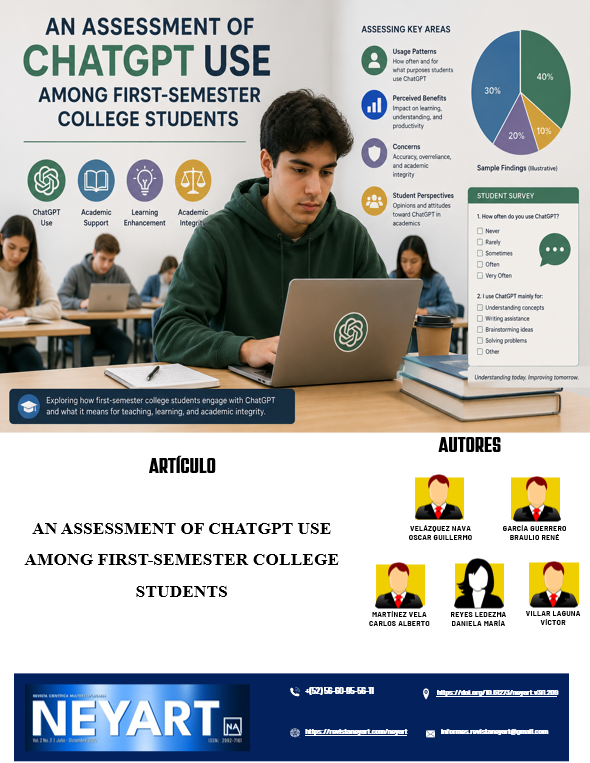
An assessment of ChatGPT use among first-semester college students
DOI:
https://doi.org/10.61273/neyart.v4i1.209Palabras clave:
Academic adaptation, ChatGPT, Higher education, Academic integrity, Artificial intelligence.Resumen
This study evaluated the use, perceptions, and academic impact of ChatGPT among forty-four first-semester college students using a positivist quantitative approach. These results showed an overall low-to-moderate adoption profile consisting of limited knowledge and mostly expressive rather than academic use. The majority of academic uses included text translation and understanding content presented in class, indicating that students primarily use the tool for lower-order cognitive tasks. However, even with this early use of generative artificial intelligence, we observe significant ethical scrutiny through the lens of educational integrity from participating students expressing critical reflection. As for the downside, distraction while studying and an unwillingness to do their share were among the top issues identified, with low scores for performance decrease. To conclude, the major transition to and workload of higher learning lauds a time where adaptability and vulnerability is arguably at its peak. Consequently, explicitly pedagogic strategies and digital literacy programs should be a focus in the first years of higher education, as they have shown to foster critical skills, above all original thinking and an ethical, responsible and educational use of these technologies.
Descargas
Métricas
Citas
Creswell, J. W. (2014). Research design: Qualitative, quantitative, and mixed methods approaches (4th ed.). SAGE Publications.
Diaz-Leon, I., & Iraola-Real, I. (2024). The use of ChatGPT by Peruvian university students: An exploration of actual use and intention to use. Revista Ibérica de Sistemas e Tecnologias de Informação, E69, 89–101.
Dogaru, M., Pisică, O., Popa, C.-Ș., Răgman, A.-A., & Tololoi, I.-R. (2025). The perceived impact of artificial intelligence on academic learning. Frontiers in Artificial Intelligence, 8, Article 1611183. https://doi.org/10.3389/frai.2025.1611183
García Sánchez, O. V. (2023). Use and perception of ChatGPT in higher education. Journal of Research in Information Technologies, 11(23), 98–107. https://doi.org/10.36825/RITI.11.23.009
Hernández-Sampieri, R., Fernández-Collado, C., & Baptista-Lucio, M. P. (2014). Research Methodology (6th ed.). McGraw-Hill Interamericana.
Li, M., Enkhtur, A., Cheng, F., & Yamamoto, B. A. (2024). Ethical implications of ChatGPT in higher education: A scoping review. Journal of Interdisciplinary Studies in Education, 13(1), 55–68. https://doi.org/10.48550/arXiv.2311.14378
Loayza-Maturrano, E. F. (2024). University students’ perceptions of the use of ChatGPT in academic writing. Educare et Comunicare, 12(2), 28–38. https://doi.org/10.35383/educare.v12i2.1195
Morales Caluña, E. R., & Cervantes Díaz, D. J. (2024). University students’ perceptions and use of ChatGPT. Ciencia Latina Revista Científica Multidisciplinar, 8(5), 6872–6886. https://doi.org/10.37811/cl_rcm.v8i5.14101
Nemt-allah, M., Khalifa, W., Badawy, M., Elbably, Y., & Ibrahim, A. (2024). Validating the ChatGPT Usage Scale: Psychometric properties and factor structures among postgraduate students. BMC Psychology, 12(1), Article 576. https://doi.org/10.1186/s40359-024-01983-4
Ngo, T. T. A. (2023). The perception by university students of the use of ChatGPT in education. International Journal of Emerging Technologies in Learning (iJET), 18(17), 4–19. https://doi.org/10.3991/ijet.v18i17.39019
Ravšelj, D., Keržič, D., Tomaževič, N., Umek, L., Brezovar, N., Iahad, N. A., ... Aristovnik, A. (2025). Higher education students' perceptions of ChatGPT: A global study of early reactions. PLOS ONE, 20(2), Article e0315011. https://doi.org/10.1371/journal.pone.0315011
Ricoy, C. (2006). Contribution on research paradigms. Educação. Revista do Centro de Educação, 31(1), 11–22. https://www.redalyc.org/pdf/1171/117117257002.pdf
Soto Ortiz, J. L., & Reyes Flores, I. A. (2024). University students’ views on the use of ChatGPT. REPED. Paraguayan Journal of Distance Education, 5(2), 56–65. https://doi.org/10.56152/reped2024-dossierIA1-art5
Sullivan, M., Kelly, A., & McLaughlan, P. (2023). ChatGPT in higher education: Considerations for academic integrity and student learning. Journal of Applied Learning and Teaching, 6(1), 31–40.
Tello-Gamarra, J., & Torres-Sifuentes, M. (2025). Generative artificial intelligence among incoming students at a public university [Generative AI and incoming students]. Horizontes. Journal of Research in Education Sciences, 9(35)