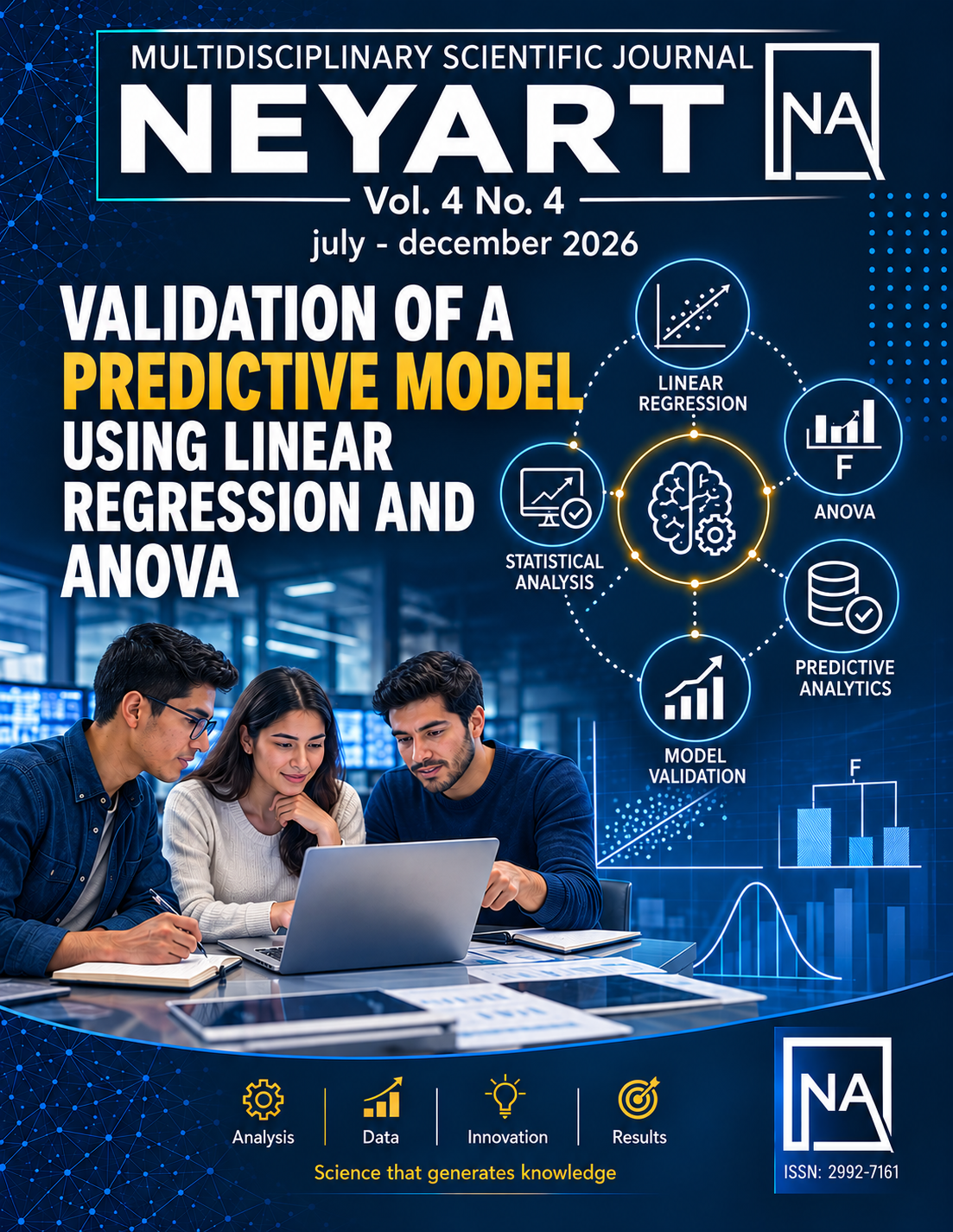
Validation of a predictive model using linear regression and anova
DOI:
https://doi.org/10.61273/neyart.v4i4.221Palabras clave:
Forecasting, Mathematical model, Planning, Quantitative methods, Statistical analysisResumen
This paper verifies a simple linear regression prediction model, whose function is to predict in advance the monthly number of new customers of an institution. This verification uses the institution's full five-year historical monthly customer growth data. The tools used to verify the reliability of the model are the commonly used Excel, and the professional statistical software Minitab 19. The specific verification method is analysis of variance, which is the ANOVA mentioned in studies. After the verification, the model draws a clear conclusion: the correlation between the passage of time and customer growth is very high. The three statistical values supporting this conclusion are the coefficient of determination R²=0.8094, the F-value=246.37, and the p-value≈0. Finally, the authors of the paper propose that in the future, these variables that may affect customer growth can all be incorporated into the model to carry out multiple regression analysis, to further help the institution formulate more reasonable decisions.
Descargas
Citas
Aguado, D., González, A., Antúnez, M., & de Dios, T. (2017). Assessment of transferable skills among college students. Initial psychometric properties of the Transferable Skills Questionnaire. REICE. Ibero-American Journal on Quality, Effectiveness, and Change in Education, 15(2), 129–152. https://doi.org/10.15366/reice2017.15.2.007
Asonitou, S. (2022). Measuring the gap between academic hard skills training and modern industry demands in higher education. Higher Education, Skills and Work-Based Learning, 12(3), 455-472. https://doi.org/10.1108/HESWBL-05-2021-0098
Asonitou, S. (2022). The digital transformation era: Redefining technical mastery and soft skills in higher education. European Journal of Higher Education, 12(3), 289-305.
García-Vargas, M., López-Maldonado, J., & Restrepo, A. (2022). Gaps in technical training upon entry into higher education in Latin America. Ibero-American Journal of Higher Education, 13(36), 88-105. https://doi.org/10.22201/iisue.20072872e.2022.36.1192
He, T., Zhang, L., & Chang, Y. (2021). The definitive role of hard skills in early engineering employment outcomes. Journal of Engineering Education Research, 29(2), 114-129. https://doi.org/10.1016/j.jeer.2021.02.004
Jones, P., & Broadbent, M. (2020). OECD metrics and the standardization of technical competencies in global higher education. Educational Evaluation Policy Analysis, 42(4), 567-584. https://doi.org/10.3102/0162373720934521
Martínez-Sánchez, F., & Rodríguez, C. (2023). Technical competencies and professional qualification frameworks in Mexican higher education. Journal of Higher Education, 52(206), 45-63. https://doi.org/10.36857/resu.2023.206.2415
Pérez-Franco, J. (2021). Structural challenges in the assessment of disciplinary skills in the Southern Cone. Quality in Education, (54), 112–139. https://doi.org/10.31619/caledu.n54.968
Ramírez, G., & González, E. (2023). Digital literacy and diagnostic quantitative skills among first-year students. Apertura, 15(1), 34–49. https://doi.org/10.32870/Ap.v15n1.2301
Silva, M., & Santos, R. (2022). Gender gaps in the self-perception of hard technological skills among college students. Latin American Journal of Educational Technology, 21(2), 75-91. https://doi.org/10.17398/1695-288X.21.2.75
Smith, J., & Martínez, K. (2023). Quantitative deficiencies in first-year university students and their correlation with retention. Journal of College Student Retention: Research, Theory & Practice, 25(1), 142-161. https://doi.org/10.1177/15210251211011342
Torres-Cáceres, L. (2024). The disconnect between hard academic skills and Latin American SMEs. Estudios Gerenciales, 40(170), 89-102. https://doi.org/10.18046/j.estger.2024.170.6120
Tymon, A. (2021). The 4.0 Industry Paradigm: Redefining Technical Mastery Within Academic Structures. Studies in Higher Education, 46(8), 1611-1624. https://doi.org/10.1080/03075079.2019.1698532
Valencia-Maldonado, G. (2023). Diagnostic competency-based assessment in Andean higher education. Formación Universitaria, 16(3), 55-66. https://doi.org/10.4067/S0718-50062023000300055
Wilson, H., & Taylor, S. (2022). Objective performance testing vs. self-assessment of technical instrument skills in freshmen. Assessment & Evaluation in Higher Education, 47(5), 789-804. https://doi.org/10.1080/02602938.2021.1963452
Zhao, Q., & Wang, Y. (2024). Technological hard skills entry requirements and academic adaptations in STEM fields. International Journal of Educational Research, 123, 102-117. https://doi.org/10.1016/j.ijer.2023.102117