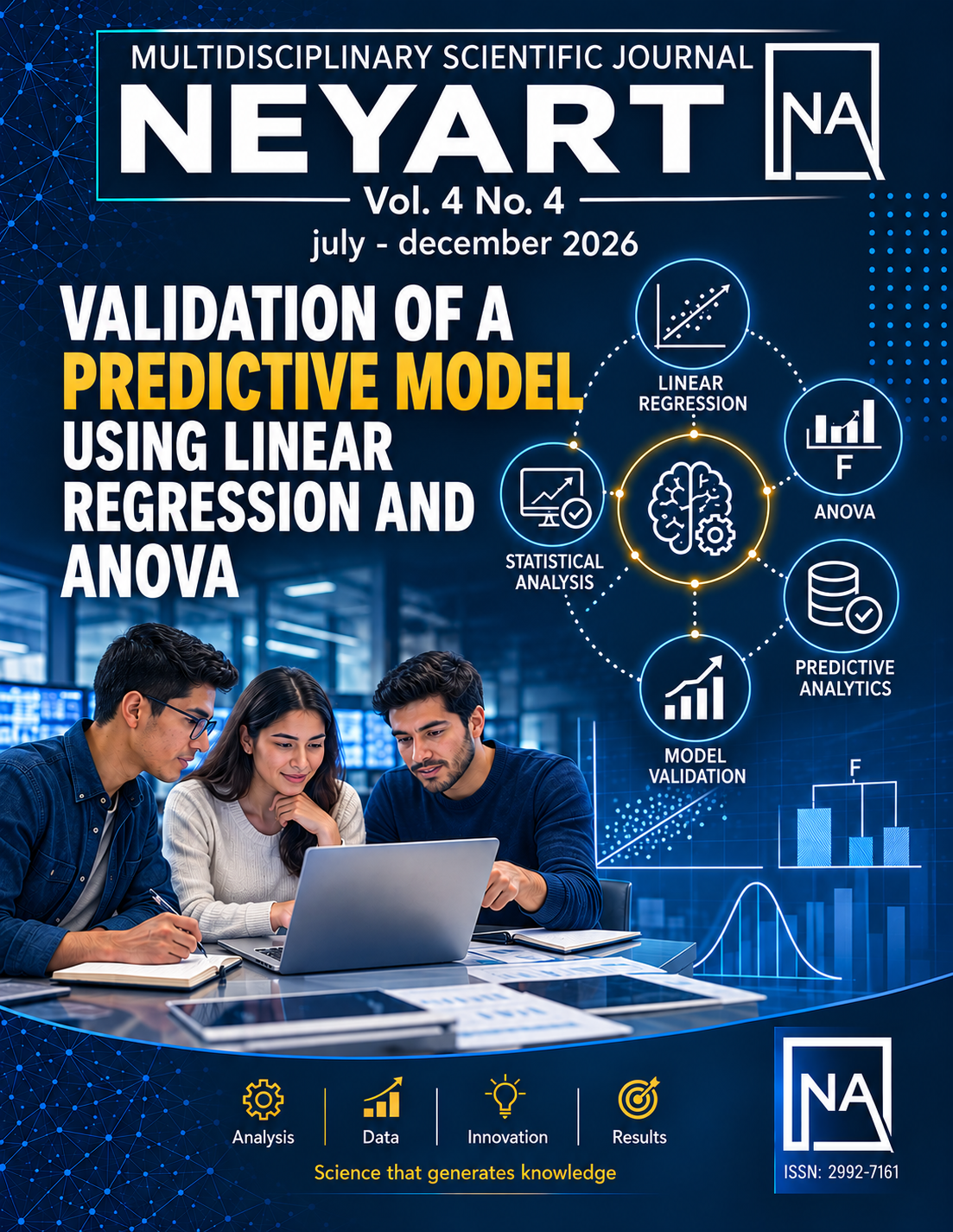
Validación de un modelo predictivo mediante regresión lineal y anova
DOI:
https://doi.org/10.61273/neyart.v4i4.221Keywords:
Previsión, Modelo matemático, Planificación, Métodos cuantitativos, Análisis estadísticoAbstract
Este artículo verifica un modelo de predicción de regresión lineal simple, cuya función es predecir con anticipación el número mensual de nuevos clientes de una institución. Esta verificación utiliza el conjunto completo de datos históricos de crecimiento mensual de clientes de la institución durante cinco años. Las herramientas utilizadas para verificar la confiabilidad del modelo son el programa Excel, de uso común, y el software estadístico profesional Minitab 19. El método específico de verificación es el análisis de varianza, conocido como ANOVA, mencionado en diversos estudios. Tras la verificación, el modelo llega a una conclusión clara: la correlación entre el paso del tiempo y el crecimiento de la clientela es muy alta. Los tres valores estadísticos que respaldan esta conclusión son el coeficiente de determinación R² = 0,8094, el valor F = 246,37 y el valor p ≈ 0.. Finalmente, los autores del artículo proponen que, en el futuro, estas variables que pueden afectar el crecimiento de la clientela se incorporen al modelo para realizar un análisis de regresión múltiple, con el fin de ayudar aún más a la institución a tomar decisiones más razonables.
Downloads
References
Aguado, D., González, A., Antúnez, M., & de Dios, T. (2017). Assessment of transferable skills among college students. Initial psychometric properties of the Transferable Skills Questionnaire. REICE. Ibero-American Journal on Quality, Effectiveness, and Change in Education, 15(2), 129–152. https://doi.org/10.15366/reice2017.15.2.007
Asonitou, S. (2022). Measuring the gap between academic hard skills training and modern industry demands in higher education. Higher Education, Skills and Work-Based Learning, 12(3), 455-472. https://doi.org/10.1108/HESWBL-05-2021-0098
Asonitou, S. (2022). The digital transformation era: Redefining technical mastery and soft skills in higher education. European Journal of Higher Education, 12(3), 289-305.
García-Vargas, M., López-Maldonado, J., & Restrepo, A. (2022). Gaps in technical training upon entry into higher education in Latin America. Ibero-American Journal of Higher Education, 13(36), 88-105. https://doi.org/10.22201/iisue.20072872e.2022.36.1192
He, T., Zhang, L., & Chang, Y. (2021). The definitive role of hard skills in early engineering employment outcomes. Journal of Engineering Education Research, 29(2), 114-129. https://doi.org/10.1016/j.jeer.2021.02.004
Jones, P., & Broadbent, M. (2020). OECD metrics and the standardization of technical competencies in global higher education. Educational Evaluation Policy Analysis, 42(4), 567-584. https://doi.org/10.3102/0162373720934521
Martínez-Sánchez, F., & Rodríguez, C. (2023). Technical competencies and professional qualification frameworks in Mexican higher education. Journal of Higher Education, 52(206), 45-63. https://doi.org/10.36857/resu.2023.206.2415
Pérez-Franco, J. (2021). Structural challenges in the assessment of disciplinary skills in the Southern Cone. Quality in Education, (54), 112–139. https://doi.org/10.31619/caledu.n54.968
Ramírez, G., & González, E. (2023). Digital literacy and diagnostic quantitative skills among first-year students. Apertura, 15(1), 34–49. https://doi.org/10.32870/Ap.v15n1.2301
Silva, M., & Santos, R. (2022). Gender gaps in the self-perception of hard technological skills among college students. Latin American Journal of Educational Technology, 21(2), 75-91. https://doi.org/10.17398/1695-288X.21.2.75
Smith, J., & Martínez, K. (2023). Quantitative deficiencies in first-year university students and their correlation with retention. Journal of College Student Retention: Research, Theory & Practice, 25(1), 142-161. https://doi.org/10.1177/15210251211011342
Torres-Cáceres, L. (2024). The disconnect between hard academic skills and Latin American SMEs. Estudios Gerenciales, 40(170), 89-102. https://doi.org/10.18046/j.estger.2024.170.6120
Tymon, A. (2021). The 4.0 Industry Paradigm: Redefining Technical Mastery Within Academic Structures. Studies in Higher Education, 46(8), 1611-1624. https://doi.org/10.1080/03075079.2019.1698532
Valencia-Maldonado, G. (2023). Diagnostic competency-based assessment in Andean higher education. Formación Universitaria, 16(3), 55-66. https://doi.org/10.4067/S0718-50062023000300055
Wilson, H., & Taylor, S. (2022). Objective performance testing vs. self-assessment of technical instrument skills in freshmen. Assessment & Evaluation in Higher Education, 47(5), 789-804. https://doi.org/10.1080/02602938.2021.1963452
Zhao, Q., & Wang, Y. (2024). Technological hard skills entry requirements and academic adaptations in STEM fields. International Journal of Educational Research, 123, 102-117. https://doi.org/10.1016/j.ijer.2023.102117