
Smart cane prototype for people with visual impairment: Design, implementation and evaluation
DOI:
https://doi.org/10.61273/neyart.v3i5.128Keywords:
Visual impairment, smart cane, ultrasonic sensor, Arduino, accessibilityAbstract
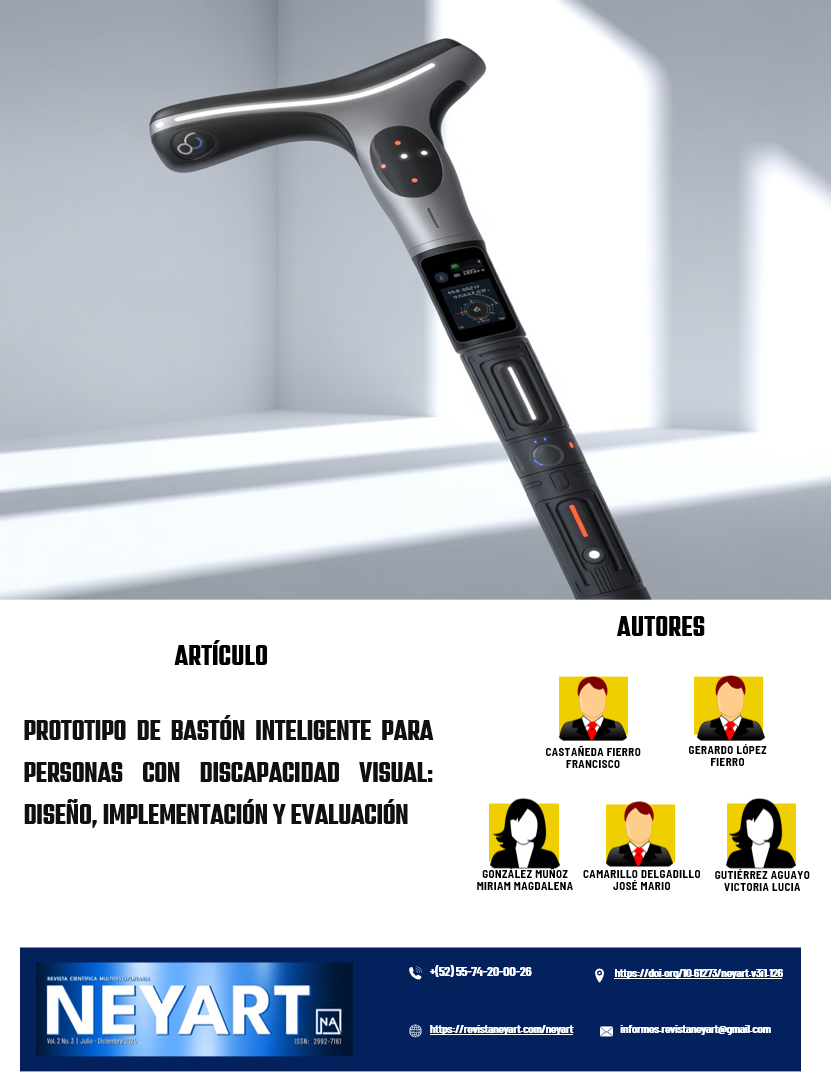
This article describes the design, implementation, and experimental validation of a smart cane for people with visual impairments, based on an integrated electronic system. The prototype incorporates an ultrasonic sensor (HC-SR04) for the detection of terrain irregularities and obstacles on public roads. The signal is processed by an Arduino Nano microcontroller and transformed into a vibration signal that alerts the user to the presence of obstacles. The device also includes a Neopixel LED light strip controlled by a light sensor (LDR), which automatically activates in low light conditions to improve the visibility of the user by other pedestrians. It also has an audible alert system that activates when the cane falls from his hand, making it easier to locate. The development process was organized using a methodology based on prototypes and key results-based planning (OKR), which allowed for a structured and efficient execution. Tests conducted in simulated urban environments validated the system's operation, highlighting its usefulness as an accessible tool to support independent mobility in contexts with poor infrastructure.
Downloads
Metrics
References
Adafruit Industries. (s.f.). Adafruit NeoPixel Library Reference. Recuperado de https://learn.adafruit.com/adafruit-neopixel-uberguide
Arduino.cc. (2023). Arduino Nano Overview. Recuperado de https://www.arduino.cc
Borderzine. (2014). Personas con discapacidad visual enfrentan riesgos al caminar por Ciudad Juárez. Recuperado de https://borderzine.com
Cytron Technologies. (2013). HC-SR04 Ultrasonic Sensor Technical Datasheet. Recuperado de https://www.cytron.io
EasyBuzzer. (s.f.). EasyBuzzer Arduino Library. Recuperado de https://github.com/evert-arias/EasyBuzzer
El Heraldo de Chihuahua. (2023). Personas con discapacidad enfrentan rezago y barreras en la infraestructura urbana. Recuperado de https://www.heraldodechihuahua.com.mx
Gobierno de México. (2016). Normas de uso del bastón blanco para personas con discapacidad visual. Recuperado de https://www.gob.mx
Gutiérrez Aguayo, V. L. (2023). Diseño y construcción de un bastón inteligente para personas invidentes [Tesis de licenciatura, Instituto Tecnológico de Ciudad Juárez]. ITCJ.
Instituto Nacional de Estadística y Geografía (INEGI). (2020). Censo de Población y Vivienda 2020. Recuperado de https://www.inegi.org.mx
La Bobina de Tesla. (2021). Circuito Pull-down con fotorresistencia. Recuperado de https://labobinadetesla.com
Ontiveros, M., Rojas, C., & Martínez, A. (2014). Diseño y construcción de un bastón blanco electrónico para personas invidentes. Instituto Tecnológico Superior de Huauchinango.
Organización Mundial de la Salud (OMS). (2020). Informe mundial sobre la visión 2020. Recuperado de https://www.who.int
Slade, P., Tambe, T., & Raitor, M. (2021). Smart Cane Project. Stanford University.
Tsormpatzoudis, C. (2016). Smart Mobility Aid for the Visually Impaired Using 3D Printing and Sensors. University of Manchester.
WeWalk. (2017). Smart Cane Technology. Recuperado de https://wewalk.io
Downloads
Published

How to Cite
Issue
Section
License
Copyright (c) 2025 Francisco Castañeda Fierro , Gerardo López Fierro, Miriam Magdalena González Muñoz , José Mario Camarillo Delgadillo , Victoria Lucia Gutiérrez Aguayo

This work is licensed under a Creative Commons Attribution 4.0 International License.