
The influence of pre-hispanic gastronomic utensils on the ambience of traditional and baroque cuisine restaurants in puebla
DOI:
https://doi.org/10.61273/neyart.v3i3.144Keywords:
Pre-Hispanic utensils, traditional Puebla cuisine, traditional food restaurants in Puebla, perception of ambianceAbstract
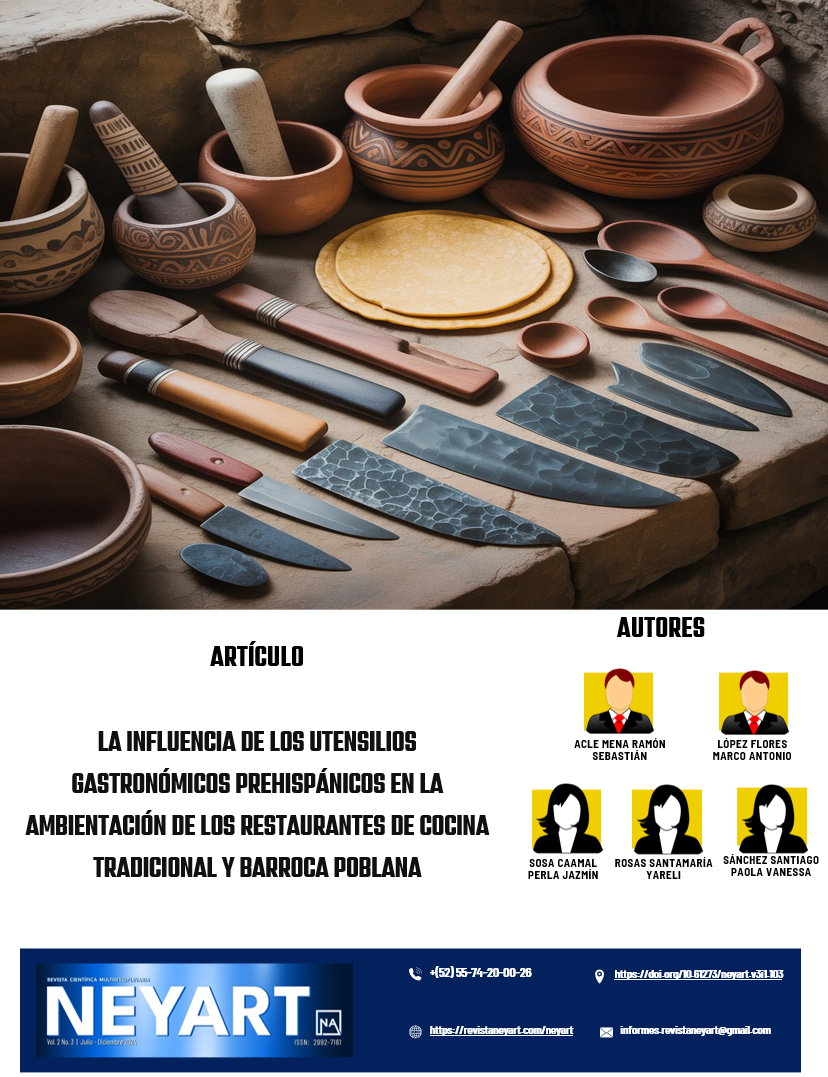
This article analyzes the influence of pre-Hispanic gastronomic utensils on the ambience of traditional and Baroque cuisine restaurants in Puebla, highlighting their historical, aesthetic, and cultural value within Mexico’s culinary heritage. In the face of global gastronomic homogenization, the importance of preserving identity-defining elements such as the metate, molcajete, comal, molinillo, comitalli, and clay pots is emphasized, as these utensils fulfill not only culinary functions but also symbolic and decorative roles.
The general objective was to determine the influence of these utensils on the ambience of traditional and Baroque restaurants in Puebla. The hypothesis proposed a direct and positive relationship between their presence and the perception of the environment, the diner’s sensory experience, and the authenticity of the space.
The methodology followed a quantitative approach with a descriptive–correlational design. A survey was administered to diners in restaurants located in Puebla’s Historic Center, selected through convenience sampling. The instrument was based on four variables: Style, Decoration, Dish Presentation, and Gastronomic Memory, each consisting of four items evaluated on a five-point Likert scale. The reliability of the instrument was confirmed with a Cronbach’s Alpha above 0.80.
The results showed a high appreciation for traditional utensils, with Gastronomic Memory and Decoration standing out as the variables with the greatest positive impact. The findings indicate that these elements evoke cultural heritage and reinforce Puebla’s culinary identity. Finally, the hypothesis is confirmed by demonstrating that pre-Hispanic utensils contribute not only to functionality but also to authenticity and a sense of belonging within the dining experience.
Downloads
Metrics
References
Acevez, J. L. (2025). La cocina tradicional mexicana: un patrimonio vivo para el bienestar de la sociedad y del planeta. UNESCO. Obtenido de https://www.unesco.org/es/articles/la-cocina-tradicional-mexicana-un-patrimonio-vivo-para-el-bienestar-de-la-sociedad-y-del-planeta
Aliseda, A. (2022). Comal: Un antiguo caballo de batalla hecho nuevo y construido para durar. Masienda. https://masienda.com/es/blogs/learn/comal-an-ancient-workhorse-made-new-and-built-tolast?srsltid=AfmBOop_U_bdsew9LPvZVVeooz0GHrlNmqZAtDYuoDHykJG0PZlSP8RU
Apresyan. (2020). The Marketing of Scent: The Effect of Ambient Scent on Restaurant Customers´ Behavior in Armenia. American University of Armenia. https://lusineapresyan.altervista.org/wp-content/uploads/2024/03/Capstone_Thesis_Lusine_Apresyan.pdf
Armendáriz, C. (2024). Territorio y estrategias de producción de metate en Turícuaro. UNAM. https://geogaceta.geofisica.unam.mx/index.php/2024/08/23/territorio-y-estrategias-de-produccion-de-metate-en-turicuaro/?utm_source
Barra Hernández, V., & Pérez Martínez, S. (2020). La gastronomía poblana como recurso turístico cultural: Una reflexión al panorama actual. Plataforma Abierta De Libros Y Memorias Académicas - PALMA, 132–147. https://cipres.sanmateo.edu.co/ojs/index.php/libros/article/view/383 DOI: https://doi.org/10.7476/9786289558210.0005
Beteta, M. (2023). mbmarcobeteta. https://mbmarcobeteta.com/restaurantes-cocina-poblana/
Cabrera, O. (2023). El mundo de los atoles. Larousse.
Cabrero. (2019). Arqueologia del Occidente de Mexico II. https://www.laiesken.net/advances/volume/AA05.pdf
Cortés García, F. (2014). Compendio de los utensilios en la cocina mexicana [Trabajo de grado, Universidad Nacional Autónoma de México]. Universidad Nacional Autónoma de México.
El informador. (2015). Mole de caderas, platillo de reminisciencias prehispánicas. El informador. https://www.informador.mx/Cultura/Mole-de-Caderas-platillo-de-reminiscencias-prehispanicas-20151013-0163.html
El Siglo de Durango. (2020). Historia del comal. El Siglo de Durango. https://www.elsiglodedurango.com.mx/noticia/2020/historia-del-comal.html?from=old
García, C. & Ancona, M. del C. (2022). Gastronomía tradicional, identidad y emprendimiento. Los 200 años de la creación del chile en nogada. Journal of Tourism and Heritage Research, 5(2), 1-15. https://dialnet.unirioja.es/servlet/articulo?codigo=9064236
García, R. (2006). Cocina Prehispánica mexicana. Panorama. https://books.google.es/books?hl=es&lr=&id=EJuKSkd5K94C&oi=fnd&pg=PA7&dq=garc%C3%ADa+rivas+heriberto&ots=cqb2qEejP1&sig=DOo2y1eGgIY8MierLlLB0rYO43k#v=onepage&q=garc%C3%ADa%20rivas%20heriberto&f=false
González, J. V. (2013). Servicio en Restaurante. Editorial CEP, S.L.
Helmholtz. (1867). Handbuch der physiologischen Optik. Enciclopedia de filosofía de Stanford. de https://plato.stanford.edu/entries/hermann-helmholtz
Krishna, A. (2012). An integrative review of sensory marketing: Engaging the senses to affect perception, judgment and behavior. Journal of consumer psychology, 22(3), 332-351. https://www.sciencedirect.com/science/article/abs/pii/S1057740811000830 DOI: https://doi.org/10.1016/j.jcps.2011.08.003
Laborde, G., & Medina, F. X. (2015). De los recetarios nacionales a los expedientes patrimoniales. Una confrontación de identidades y políticas culturales. Estudios del hombre. https://es.scribd.com/document/391734523/Laborde-Medina-2015-de-Los-Recetarios-Nacionales-a-Los-Expedientes-Patrimoniales
Long Towell, J. (2010). Invenciones e innovaciones. La evolución de la tecnología alimentaria mesoamericana. Investigación y Ciencia, 18(46), 4-9. https://www.redalyc.org/articulo.oa?id=67413508002
Lozano, G. (19 de Marzo de 2018). Arte sano, arte sana: Las maravillas de las artesanías. Canaco. https://sc.puebla.gob.mx/media/k2/attachments/Revista_Poblanidades_03.pdf
Mejía, A. (2020). Gastronomía y turismo: una reflexión cultural. Fundación Universitaria San Mateo. https://books.scielo.org/id/t267z/pdf/nieto-9786289558210.pdf#page=134
Meléndez Torres, J. M., & Cañez De la Fuente, G. M. (2009). La cocina tradicional regional como un elemento de identidad y desarrollo local: el caso de San Pedro El Saucito, Sonora, México. Estudios socialeS, 17(spe), 181-204. http://www.scielo.org.mx/scielo.php?script=sci_arttext&pid=S0188-45572009000300008&lng=es&tlng=es
Mendoza, A. A. (2020). Elementos atmosféricos y calidad del servicio como determinantes de la satisfacción del consumidor de restaurantes con temática de cine en Lima Metropolitana [Trabajo de grado, Universidad Peruana de Ciencias Aplicadas]. Repositorio de Universidad Peruana de Ciencias Aplicadas. https://repositorioacademico.upc.edu.pe/bitstream/handle/10757/655190/MendozaA_A.pdf?sequence=3&isAllowed=y
MéxicoHistorico. (2022). El legado culinario de los Nahuas de la Sierra Norte de Puebla. MéxicoHistorico: https://www.mexicohistorico.com/paginas/el_legado_culinario_de_los_nahuas_de_la_sierra_norte_de_puebla.html
Montemayor, S. (2021). Historia del molcajete. CEMCUI. https://cemcui.com/blogs/noticias/historia-del-molcajete
Museo Amparo. (2022). Olla azteca III. Fundación Amparo. Museo Amparo. https://museoamparo.com/colecciones/pieza/3457/olla-azteca-iii
Nessim. (2017). Consumer perception from consumer behavior: An applied Approach. Kendall Hunt Publishing. https://he.kendallhunt.com/sites/default/files/heupload/pdfs/Hanna_5e_Ch3.pdf
Niosi, A. (2021). The perceptual process. Introduction To Consumer Behaviour. OpenEd. https://opentextbc.ca/introconsumerbehaviour/chapter/the-perceptual-process/
Ntx. (2011). Gastronomía poblana, fusión de las cocinas mexicanas y europeas. Informador.mx. https://www.informador.mx/Cultura/Gastronomia-poblana-fusion-de-las-cocinas-mexica-y-europea-20110205-0052.html
Orozco, M. (2001). La Importancia del Rescate de la Comida Barroca como Arte Culinario dentro de la Gastronomia del Estado de Puebla. Instituto Politécnico Nacional. https://es.scribd.com/document/255824340/Tesis-Lic-Monse-Sanchez-Orozco-y-Co
Palmer, M. (2012). A century of Gestalt psychology in visual perception: I. Perceptual grouping and figure–ground organization. Psychological bulletin, 138(6), 1172. DOI: https://doi.org/10.1037/a0029333
Ricatto. (2022). La historia del comal. Ricatto del norte. https://ricatto.com.mx/la-historia-del-comal/
Rodríguez, E. (2023). Este es el origen de los deliciosos molotes de Puebla. El universal. https://www.eluniversalpuebla.com.mx/ciudad/este-es-el-origen-de-los-deliciosos-molotes-de-puebla
Segura Ronquillo , S.C. , Albán Alaña , L.F. y Samaniego López , J.M. 2025. Elementos atmosféricos en el servicio de restaurantes y su incidencia en la satisfacción del comensal. Turismo y Sociedad. (37), 253–279. https://doi.org/10.18601/01207555.n37.10 DOI: https://doi.org/10.18601/01207555.n37.10
TasteAtlas. (2024). 100 Best Cuisines. Tasteatlas awards. https://www.tasteatlas.com/best/cuisines
UNESCO. (2010). Comida mexicana, Patrimonio Cultural Inmaterial de la Humanidad. UNESCO. https://ich.unesco.org/es/RL/la-cocina-tradicional-mexicana-una-cultura-comunitaria-ancestral-y-viva-y-el-paradigma-de-michoacan-00400
Vázquez, A. (2024). Cocina Poblana. Larousse.
Walters, R. (1989). Consumer perception. A Decision-Making Approach. South-Western Publishing Company.
Wundt, W. (1874). Grundzüge der physiologischen Psychologie. Britannica. https://www.britannica.com/biography/Wilhelm-Wundt
Zurita, R. M. (2018). Diccionario enciclopédico de la Gastronomía Mexicana. Larousse.
Downloads
Published

How to Cite
Issue
Section
License
Copyright (c) 2025 Ramón Sebastián Acle Mena , Marco Antonio López Flores , Perla Jazmín Sosa Caamal , Yareli Rosas Santamaría , Paola Vanessa Sánchez Santiago

This work is licensed under a Creative Commons Attribution 4.0 International License.