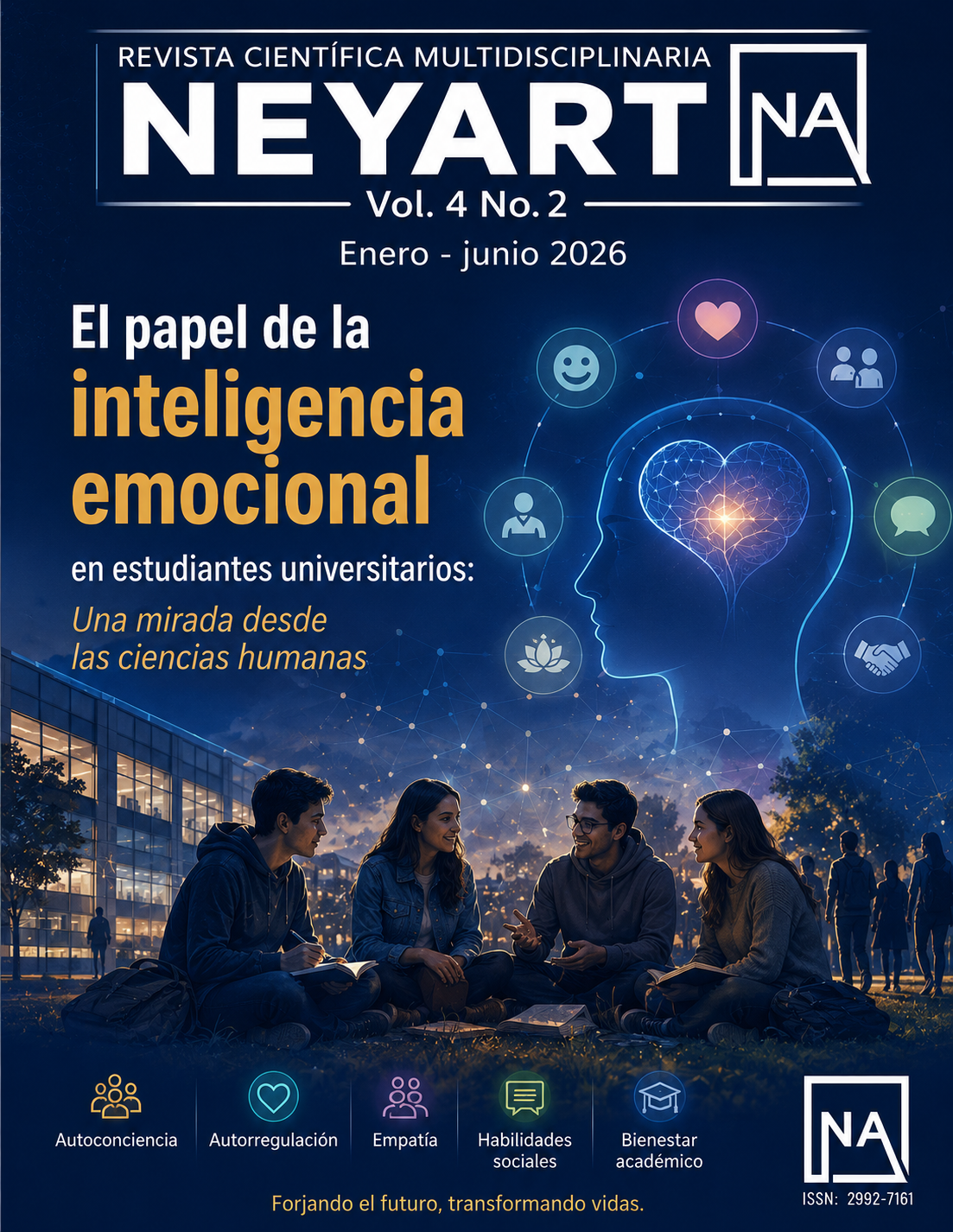
The role of emotional intelligence in university students: A perspective from the humanities
DOI:
https://doi.org/10.61273/neyart.v4i2.158Keywords:
Emotional intelligence, Empathy, Holistic educationAbstract
The present research, titled “The Role of Emotional Intelligence in University Students: A Perspective from the Human Sciences,” aimed to achieve this objective through documentary reviews for writers and a content analysis of previous cases of some students, highlighting theoretical trends from the perspective of emotional intelligence. At this stage, and within the content analysis, case studies were selected and the topic was coded; the results were compared and interpreted by others. The findings indicate that emotional competencies (namely self-awareness, empathy, and emotional regulation) predict students’ academic and social adjustment. As Goleman (1995) observes, emotional intelligence is a stronger predictor of success in life than intelligence quotient; it appears to be more important in educational contexts where social and emotional skills determine the outcome. Bar-On (2000) further suggests the role of emotional competencies in the early years of university students, as it is critical for achieving success in higher education. Therefore, it is of vital importance to establish different training initiatives aimed at increasing emotional intelligence in tertiary education so that growth is holistic and both cognitive and socio-emotional aspects can be developed in both settings.
Downloads
Metrics
References
Bar-On, R. (2000). Emotional and social intelligence: Insights from the Emotional Quotient Inventory (EQ-i). In R. Bar-On & J. D. A. Parker (Eds.), Handbook of emotional intelligence (pp. 363–388). Jossey-Bass.
Basto Herrera, I. C., Barrón Parado, J. C., & Garro Aburto, L. L. (2021). Importancia del desarrollo de la motricidad fina en la etapa preescolar para la iniciación en la escritura. Religación. Revista de Ciencias Sociales y Humanidades, 6(30), 1–9. DOI: https://doi.org/10.46652/rgn.v6i30.834
https://scholar.google.es/scholar?hl=es
Block, J., & Kremen, A. M. (1996). IQ and ego-resiliency: Conceptual and empirical connections and separateness. Journal of Personality and Social Psychology, 70(2), 349–361.
https://doi.org/10.1037/0022-3514.70.2.349 DOI: https://doi.org/10.1037/0022-3514.70.2.349
Boyatzis, R. E., Goleman, D., & Rhee, K. (2000). Clustering competence in emotional intelligence: Insights from the Emotional Competence Inventory (ECI). In R. Bar-On & J. D. A. Parker (Eds.), Handbook of emotional intelligence (pp. 343–362). Jossey-Bass.
Brackett, M. (2019). Permission to feel: Unlock the power of emotions to help our kids, ourselves, and our society thrive. Celadon Books.
Caruso, D. R., & Salovey, P. (2002). El directivo emocionalmente inteligente: Cómo desarrollar y usar las cuatro habilidades emocionales clave del liderazgo. Jossey-Bass.
David, S. (2016). Agilidad emocional: Libérate, acepta el cambio y prospera en el trabajo y en la vida. Avery.
Ekman, P. (2003). Emociones reveladas: Cómo reconocer las expresiones faciales y mejorar la comunicación. Times Books.
Furnham, A., & Petrides, K. V. (2001). Trait emotional intelligence: Psychometric investigation with reference to established trait taxonomies. European Journal of Personality, 15(6), 425–448.
https://doi.org/10.1002/per.416 DOI: https://doi.org/10.1002/per.416
Gardner, H. (1983). Estructuras de la mente: La teoría de las inteligencias múltiples. Basic Book.
Goleman, D. (1995). Emotional intelligence. Bantam Books. (Versión en español: Goleman, D. (1996). La inteligencia emocional. Editorial Kairós.)
Goleman, D. (1998). Working with emotional intelligence. Bantam Books. (Versión en español: Goleman, D. (1999). La práctica de la inteligencia emocional. Editorial Kairós.)
Machuca Solé, C. F. (2022). Zona Emovere: Neuroeducación y acción emocional. Editorial Emovere.
Mayer, J. D., & Salovey, P. (1997). What is emotional intelligence? In P. Salovey & D. Sluyter
(Eds.), Emotional development and emotional intelligence: Educational implications (pp. 3–31). Basic Books.
Newman, M. (2007). Emotional capitalists: The new leaders. John Wiley & Sons.
Niño-González, J., García-García, A., & Caldevilla-Domínguez, D. (2017). La educación emocional en la universidad: Retos y oportunidades. Revista de Estudios e Investigación en Psicología y Educación, 4(2), 112–120.
Otero Bocanegra, P. C., & Quenema Camacho, N. (2025). Inteligencia emocional como factor clave en la educación: una revisión sistemática. Dialnet.