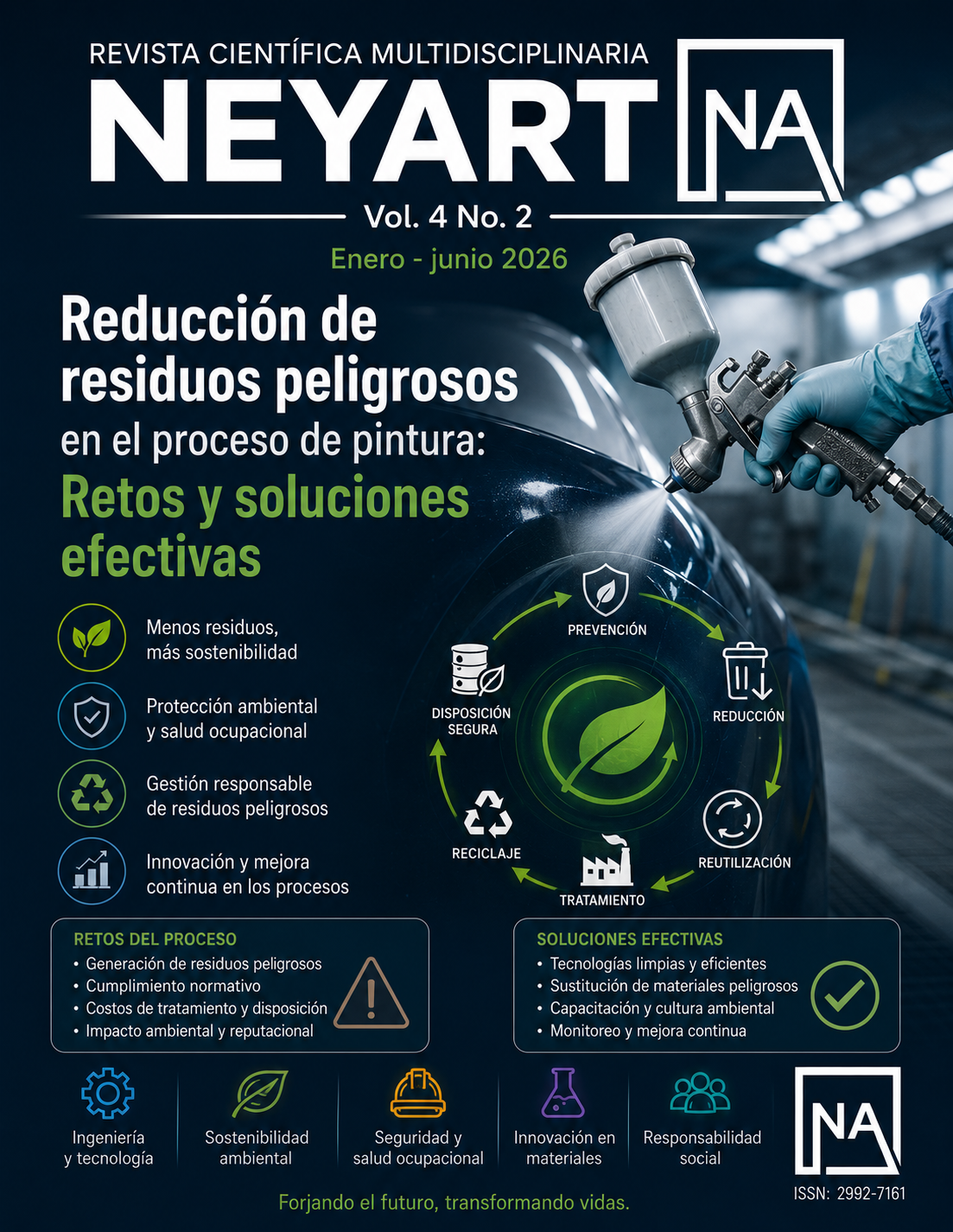
Reducing hazardous waste in the painting process: Chalenges and effective solutions
DOI:
https://doi.org/10.61273/neyart.v4i2.163Keywords:
Environmental impact, painting process, hazardous wasteAbstract
The results obtained from a strategic plan that allows for the inclusion of effective solutions to reduce the generation of hazardous waste in paint are presented. This initiative arose in response to an obvious problem in companies: the accumulation of this waste not only has a considerable environmental impact but also poses a risk to workers' health and can lead to legal and financial penalties for non-compliance with environmental regulations. Therefore, there was an urgent need to propose viable and, above all, sustainable solutions. The research took a qualitative and descriptive methodological approach, seeking to gain a comprehensive understanding of the painting process in order to analyze why and how this waste was being generated. Everything from daily operating practices to compliance with the current regulatory framework was evaluated, and strategies that could be implemented were outlined, analyzing available resources and actual conditions within the plant. A continuous improvement approach was also adopted using the PDCA (Plan, Do, Check, Act) cycle. This was complemented by key engineering tools to visualize critical waste generation points, which made it possible to build a clear picture across different areas. A substantial reduction in the amount of waste generated and, in the costs, associated with its management was achieved. Likewise, a proactive organizational culture was adopted. The results are projected to be encouraging, both in environmental and operational terms. This research allowed not only to analyze a specific problem, but also to lay the foundations for a profound change in the way of working. It demonstrated that, with the right tools and the will to improve, it is possible to transform complex processes into more efficient, safer, and environmentally friendly practices.
Downloads
Metrics
References
Albright, C. S., Wayne, W. L., & Christopher, Z. L. (2001). Data analysis and decision. Duxbury Press.
Anafapyt. (2023). Estadísticas del sector de pinturas y recubrimientos en México. https://www.anafapyt.org.mx/
Asociación Mexicana de Distribuidores de Automotores (AMDA). (2025). Guía rápida de residuos peligrosos. e3 Consultora Ambiental.
ASTM International. (2011). ASTM D16-11: Terminology for paint, related coatings, materials, and applications.
BSL Marketing. (2025, abril 14). Pintura industrial: Tipos y características. FM SPRAY. https://productosfm.com/pintura-industrial-tipos-y-caracteristicas/
Cym Materiales S. A. (2015). Preparación de superficie.
Dunn-Edwards Corporation. (s. f.). Formación de nata de pintura. Dunn-Edwards®.
Giraldo, J., & Gómez, L. (2018). Gestión ambiental y residuos. Ecoe Ediciones.
González, R., & Hernández, L. (2020). Recubrimientos industriales y corrosión. Trillas.
González-Morales, A., & Ramírez-Fuentes, H. (2022). Evaluación de la eficiencia en la gestión de residuos peligrosos en la industria manufacturera. Revista Mexicana de Ciencias Ambientales, 45–60.
Hillary, R. (2017). ISO 14001: Case studies and practical experiences. Routledge. DOI: https://doi.org/10.4324/9781351282765
Hillier, F. S., & Lieberman, G. J. (2007). Investigación de operaciones (7ª ed.). McGraw-Hill.
International Organization for Standardization. (2015, marzo 12). ISO 14001:2015. Environmental management systems — Requirements with guidance for use. https://www.iso.org/es/norma/14001
Ituarte, J. R. (2005). NOM-052-SEMARNAT-2005. Diario Oficial de la Federación.
León, E. Z. (2019). Reglamento en materia de evaluación de impacto ambiental. Diario Oficial de la Federación.
López, J. (2019). Tecnología de pinturas y recubrimientos. Alfaomega.
López-López, J. M. (2021). Cumplimiento normativo y percepción social de los residuos peligrosos en el sector minero mexicano (Tesis de maestría, Universidad Nacional Autónoma de México).
Madrid, M. D. (2023). Ley General del Equilibrio Ecológico y la Protección al Ambiente (LGEEPA). Diario Oficial de la Federación.
Marroquín, J. M. (2018). Diseño de un sistema de gestión de residuos del proceso de enderezado y pintura para la reducción del impacto sobre el medio ambiente de la ciudad de Guatemala (Tesis de licenciatura, Universidad de San Carlos de Guatemala).
OCDE. (2015). Análisis de los resultados medioambientales.
Quesada, V. F. (2014). Reglamento de la Ley General para la Prevención y Gestión Integral de los Residuos (LGPGIR). Diario Oficial de la Federación.
Quesada, V. F. (2023). Ley General para la Prevención y Gestión Integral de Residuos. Diario Oficial de la Federación.
Universidad Nacional de La Plata. (s. f.). Aplicación de pinturas. https://host170.sedici.unlp.edu.ar/server/api/core/bitstreams/4b5552a8-80da-45d3-84b1-961493c4fa3e/content