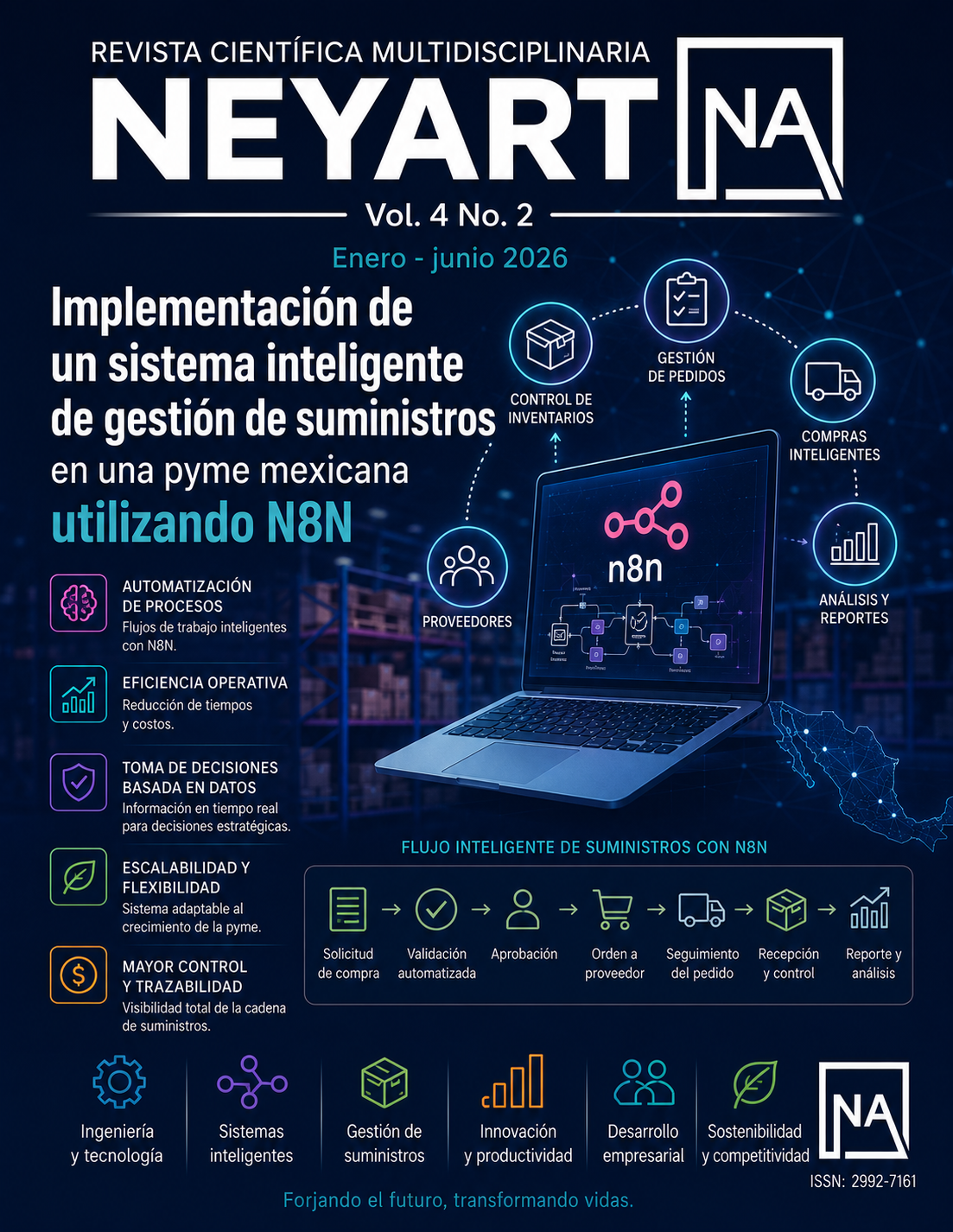
Implementation of an intelligent supply management system in a mexican sme using N8N
DOI:
https://doi.org/10.61273/neyart.v4i2.165Keywords:
Artificial intelligence, Automation, Information systems, Small and medium-sized, Supply managementAbstract
Supply management was a key factor for the operational efficiency of small and medium-sized enterprises (SMEs), particularly in the food industry, where the timely availability of raw materials and packaging ensured production continuity. In this context, the study aimed to evaluate, through a systematic literature review, the application of the n8n platform as an intelligent supply management model in a Mexican SME dedicated to packaging 13 peanut flavors. To achieve this, the SALSA methodology (Search, Appraisal, Synthesis, Analysis) was applied, which allowed a rigorous structuring of the search, selection, and analysis of scientific studies related to the automation of supply management through artificial intelligence.
Consequently, the results showed that approximately 70 % of the studies reported improvements in supply cycle efficiency, while 60 % demonstrated a reduction in inventory errors, and 55 % showed optimization in supplier coordination. Additionally, it was observed that the integration of AI enabled an average 25 % acceleration in procurement and demand forecasting processes. Therefore, a gap was identified in the literature regarding the specific implementation of n8n in Mexican SMEs, highlighting opportunities to develop applied models that integrate automation, predictive analytics, and sustainability in supply processes, thus connecting theoretical insights with practical industry needs.
Downloads
Metrics
References
Arango-Palacio, I. C. (2021). Oportunidades para la transformación digital de la cadena de suministro del sector bananero basado en software con inteligencia artificial. Revista Politécnica, 17(33), 47–63. https://doi.org/10.5281/zenodo.5526145 DOI: https://doi.org/10.33571/rpolitec.v17n33a4
Asociación Mexicana de la Industria de Tecnologías de Información. (2024). Reporte anual de adopción tecnológica en PyMEs mexicanas 2023–2024.
Banco Interamericano de Desarrollo, & Finnovista. (2024). Fintech y transformación digital en las PyMEs de América Latina y el Caribe.
Bryman, A., & Bell, E. (2015). Business research methods (4th ed.). Oxford University Press.
Chang, H., Liu, Y., & Zhang, Q. (2025). Consideraciones técnicas y limitaciones en la implementación de arquitecturas de automatización basadas en IA en entornos productivos. Journal of Manufacturing Systems Engineering, 12(4), 112–130.
Christopher, M. (2016). Logistics & supply chain management (5th ed.). Pearson.
Comisión Económica para América Latina y el Caribe. (2024). La transformación digital de las PyMEs en América Latina: Oportunidades y desafíos post-pandemia.
Creswell, J. W., & Creswell, J. D. (2018). Research design: Qualitative, quantitative, and mixed methods approaches (5th ed.). SAGE.
Etikan, I., Musa, S. A., & Alkassim, R. S. (2016). Comparison of convenience sampling and purposive sampling. (Información de revista y volumen pendiente), (2), 89–107. DOI: https://doi.org/10.11648/j.ajtas.20160501.11
García-Herrera, A., Martínez-López, F. J., & Vargas-Sánchez, A. (2025). Automatización low-code/no-code como catalizador de la competitividad en PyMEs: Evidencia desde México y España. (Información de revista pendiente).
IDC México, & SAP. (2022, marzo 15). 76% de las pymes mexicanas no están inmersas en la economía de la experiencia. SAP News Latinoamérica. https://news.sap.com/latinamerica/2022/03/76-de-las-pymes-mexicanas-no-estan-inmersas-en-la-economia-de-la-experiencia/
Instituto Nacional de Estadística y Geografía. (2023). Encuesta Nacional sobre Disponibilidad y Uso de Tecnologías de la Información en las Empresas (ENDUTIH) 2023.
López Nieto, S. R. (2023). Impacto de la tecnología en la generación de la industria 4.0 en las pymes: Estudio diagnóstico en empresas de la Ciudad de Puebla. RICEA Revista Iberoamericana de Contaduría, Economía y Administración, 12(24). https://doi.org/10.23913/ricea.v12i24.187 DOI: https://doi.org/10.23913/ricea.v12i24.208
Mejía Chávez, A. O., & Solleiro Rebolledo, J. L. (2024). Impacto de la vigilancia tecnológica en las pymes de la industria alimentaria. 360: Revista de Ciencias de la Gestión, 9(9). https://doi.org/10.18800/360gestion.202409.005 DOI: https://doi.org/10.18800/360gestion.202409.005
Organización para la Cooperación y el Desarrollo Económicos. (2023). SMEs and entrepreneurship outlook 2023. OECD Publishing. https://doi.org/10.1787/6f9f9b3a-en
Ramírez-Sanz, J. M., Morales-Contreras, M. F., & García-Muiña, F. E. (2024). Digitalización y resiliencia de las cadenas de suministro en PyMEs manufactureras: Un análisis post-COVID. Economía Industrial, 415, 89–102.
Saunders, M., Lewis, P., & Thornhill, A. (2009). Research methods for business students (5th ed.). Pearson.
Wali, M., Kumari, P., & Setiawan, R. (2025). Desafíos de adopción tecnológica y barreras operativas en cadenas de suministro digitales en países en desarrollo. International Journal of Logistics Systems and Management, 18(2), 89–107.