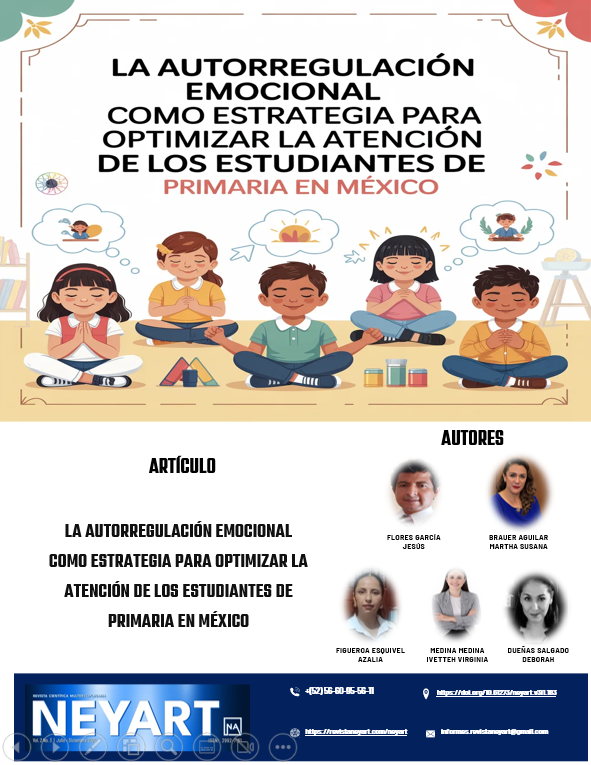
Emotional self-regulation as a strategy to optimize attention in primary school students in Mexico
DOI:
https://doi.org/10.61273/neyart.v4i1.184Keywords:
Attention, emotional self-regulation, emotional education, motivation, interpersonal relationships, academic performanceAbstract
Abstract-- The general objective of this research work is to systematize the theoretical evidence regarding the relationship between emotional self-regulation and attention span in primary school students. Utilizing a qualitative method, this study aims to establish a foundation for emotional support strategies that enhance teaching and learning within the classroom.
In Mexico’s basic education system, one of the most significant challenges is not merely the instruction of content, but also the management of emotions that facilitate information processing and the achievement of selective attention for learning. Traditionally, learning has been viewed as the direct result of a teacher's instruction; however, the reality of primary school classrooms reveals that students struggle to maintain focused attention due to emotional factors, such as difficulties in avoiding distractions and engaging with school tasks. Consequently, a lack of emotional self-regulation is observed, leading to a loss of focus during academic activities.
There is a knowledge gap where the absence of emotional self-regulation blocks selective attention, resulting in frustration and demotivation. Therefore, this documentary research seeks to analyze and substantiate how socio-emotional well-being and the understanding of emotions directly influence students' attention spans and academic achievement. Furthermore, this study proposes a series of pedagogical strategies to link emotional self-regulation with attentional processes and the improvement of students' academic performance.
Downloads
Metrics
References
Andrade González, B. (2022). Antecedentes de la educación emocional en la escuela. Anuario Mexicano de Historia de la Educación, 3(1), 201-214. https://www.rmhe.somehide.org/index.php/anuario/article/view/448/482
Bisquerra Alzina, R. (2016). Universo de emociones. PalauGea Comunicación S.L. https://www.ub.edu/grop/wp-content/uploads/2014/03/UNIVERSO-DE-EMOCIONES-R_BISQUERRA-1.pdf
Casassus, J. (2006). La educación del ser emocional (1.ª ed.). Ediciones Castillo. https://www.u-cursos.cl/facso/2016/1/PS01027/1/material_docente/detalle?id=1370911
Delgadillo Sustaita, A., y Villagrán Rueda, S. (2022). Educación emocional y procesos de aprendizaje respecto al rendimiento académico en nivel primaria. FILHA, (27), 1-17. https://www.redalyc.org/journal/6737/673772151006/html/
Gaeta, M. L. (2014). Autorregulación del aprendizaje y desempeño académico en talleres de tareas escolares. REICE. Revista Iberoamericana sobre Calidad, Eficacia y Cambio en Educación, 12(1), 103-120. https://www.redalyc.org/pdf/2831/283146484008.pdf
García Retana, J. A. (2012). La educación emocional, su importancia en el proceso de aprendizaje. Revista Educación, 36(1), 1-24. https://www.redalyc.org/articulo.oa?id=44023984007
Goleman, D. (1995). La inteligencia emocional. Ediciones B. https://iuymca.edu.ar/wp-content/uploads/2022/01/La-Inteligencia-Emocional-Daniel-Goleman-1.pdf
González-Cortez, M., & Lagos-San Martín, N. (2022). Mindfulness y autorregulación en estudiantes de educación básica: Una revisión sistemática. Revista Saberes Educativos, (9), 118-142. https://www.scielo.sa.cr/pdf/ree/v26n1/1409-4258-ree-26-01-129.pdf
González Moreno, J., Molero del Busto, M. T., & Cándido, A. (2022). Relación entre inteligencia y funciones ejecutivas en niños de siete años. Revista Iberoamericana de Psicología, 15(3), 61-72. https://www.redalyc.org/pdf/7423/742380760007.pdf
Gerrig, R. J., & Zimbardo, P. G. (2005). Psicología y vida (17.ª ed.). Pearson Educación. https://gc.scalahed.com/recursos/files/r161r/w24660w/PsicologiaYVida.Cap8.pdf
La Frase del Día. (20 de marzo de 2024). Como Gestionar tus Emociones. Marian Rojas Estape. Motivación y Superación Personal 4K [Video]. YouTube. https://www.youtube.com/watch?v=fjBueYVJpow
López Cassà, È. (2005). La educación emocional en la educación infantil. Revista Interuniversitaria de Formación del Profesorado, 19(3), 153-167. https://www.redalyc.org/articulo.oa?id=27411927009
Panadero, E., y Alonso-Tapia, J. (2014). ¿Cómo autorregulan nuestros alumnos? Revisión del modelo cíclico de Zimmerman sobre autorregulación del aprendizaje. Anales de Psicología, 30(2), 450-462. https://doi.org/10.6018/analesps.30.2.175221
Pinzón Navarro, M. I., Marín Castro, A. S., & Segura-Cardona, A. M. (2024). Prácticas educativas que favorecen la formación en autorregulación del aprendizaje de los estudiantes. ACADEMO, 11(3), 310-322. https://www.redalyc.org/journal/6882/688278763010/html/
Real Academia Española. (s.f.). Diccionario de la lengua española (Edición del Tricentenario, actualización 23.7). Recuperado el 17 de marzo de 2026, de https://dle.rae.es
Ribero-Marulanda, S., & Agudelo-Colorado, L. (2016). La autorregulación emocional. Pensamiento Psicológico, 14(2), 103-117. https://www.redalyc.org/pdf/799/79943294004.pdf
Ronqui, V., Sánchez, A., & Trías, D. (2021). La enseñanza de la autorregulación en aulas de educación primaria. Cuadernos de Investigación Educativa, 12(1), 1-18. https://www.redalyc.org/journal/4436/443670378002/html/
Trías, D., Mels, C., Huamani-Cahua, J. C., & Huamani-Cahua, L. A. (2021). Autorregulación del aprendizaje y contexto socioeconómico en estudiantes de primaria. Psicologia Escolar e Educacional, 25, 1-10. https://www.redalyc.org/journal/284/28474830006/html/
Valenzuela-Santoyo, A. C., & Portillo-Peñuelas, S. A. (2018). La inteligencia emocional en la educación primaria y su relación con el rendimiento académico. Revista Electrónica Educare, 22(3), 1-15. https://www.scielo.sa.cr/pdf/ree/v22n3/1409-4258-ree-22-03-228.pdf
Zimmerman, B. J. (2000). Lograr la autorregulación: Una perspectiva social cognitiva. En M. Boekaerts, P. R. Pintrich y M. Zeidner (Eds.), Manual de autorregulación (pp. 13-40). Academic Press. https://ssrlsig.org/wp-content/uploads/2018/01/zimmerman-2005-attaining-self-reg-a-soc-cog-perspective.pdf