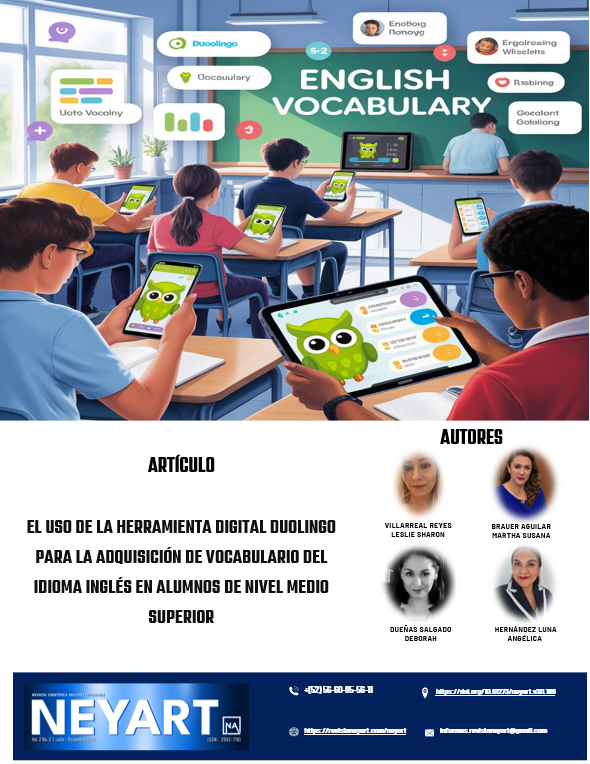
The use of the digital tool Duolingo for english vocabulary acquisition in high school students
DOI:
https://doi.org/10.61273/neyart.v4i1.186Keywords:
Duolingo, Vocabulary acquisition, tool, lexical competence, gamificationAbstract
This document, which consists of an analysis and documentary research, addresses how the integration of the digital tool Duolingo within the English classroom used as an additional resource in teaching practice favors the acquisition and reinforcement of English vocabulary. In English language learning, vocabulary is the cornerstone for developing linguistic competence. Through the versatility of the platform and gamification, this paper aims to improve and increase students' vocabulary levels. The goal is for students to progressively take ownership of the language by using and practicing it in each session, working both individually and in groups, and to apply the vocabulary acquired in a real, practical way to their daily lives.
Downloads
Metrics
References
Ajisoko, P. (2020). The Use of Duolingo Apps to Improve English Vocabulary Learning. , 15(7), 149-155. Kassel, Germany. Retrieved from International Journal of Emerging Technologies in Learning (iJET): https://www.learntechlib.org/p/217084/
Arancibia, R. (2011). Relaciones entre cantidad y calidad del conocimiento léxico y la comprensión de lectura en aprendientes de inglés como lengua extranjera. Lenguas Modernas.
Bogdan, D. (2016). Duolingo as an "Aid" to Second-language Learning An Individual Case Study. . Retrieved from http://www.ed.ehime-u.ac.jp/~kiyou/2016/pdf/20.pdf
Calvo, M. C., & Soriano., S. M. (2020). Aprendizaje De Vocabulario En Inglés Nivel Intermedio Con El Uso De Técnicas De Gamificación A Través De La Herramienta Duolingo En Los Estudiantes De Grado Once. Retrieved from Universidad de Santander: https://repositorio.udes.edu.co/server/api/core/bitstreams/25d5a903-b49a-4685-a088-b1e4ed96e320/content
Diaz, S. A. (2021). Herramienta educativa Duolingo para mejorar el vocabulario del idioma inglés en los adolescentes de la Iglesia Luz de Amor. Perú. Retrieved from https://repositorio.ucv.edu.pe/bitstream/handle/20.500.12692/69617/D%C3%ADaz_SAV SD.pdf?sequence=1.ucativo.
Figueredo, L. (2020). Percepciones de estudiantes de pregrado sobre sus habilidades para 171 la elaboración del proyecto de investigación a distancia. Revista Ciencias de la Educación. Universidad de Carabobo, Valencia, Venezuela. Retrieved from Revista Ciencias de la Educación. Universidad de Carabobo, Valencia, Venezuela.: http://servicio.bc.uc.edu.ve/educacion/revista/56e/art04.pdf
Garay, J. R. (2020). Aplicaciones de dispositivos móviles como estrategia de aprendizaje en esrudiantes universitarios de enfermería. Una mirada desde la fenomenología crítica. RIDE. Revista Iberoamericana para la Investigación y el Educativo, 8.
García Costa, L. (2021). Influencia de la Gamificación en el Aprendizaje Español como Lengua Extranjera.
Gavarri. (2021). El uso de Duolingo como herramienta de apoyo en el aprendizaje del idioma Ingl s. Conciencia Digital, 4(1.1). Retrieved from https://cienciadigital.org/revistacienciadigital2/index.php/ConcienciaDigital/article/view/1557
Gooding, F. A. (2020). Enfoques para el aprendizaje de una segunda lengua: Expectativa en el dominio del idioma inglés. https://doi.org/10.48204/j.orbis.v4n1a2. Retrieved from Revista Científica Orbis Cógnita, 4(1), Article 1.: https://doi.org/10.48204/j.orbis.v4n1a2
HERNÁNDEZ, M. y. (2006). “La revolución cognitiva en la sociedad actual: nuevos retos educativos”, Miscelánea del volumen 2006- 7 (1). Retrieved from Teoría de la educación: educación y cultura en la sociedad de la información.: http://campus.usal.es/~teoriaeducacion/ rev_numero_07/n7_art_mjhs_y_mgs.htm
Herrera, Z. B. (2019, julio-septiembre). Competencia léxica en inglés mediante el uso de la estrategia chunking flashcards. . Ciencia Digital. , Vol. 3, N°3.2, p.48- 71 ISSN: 2602-8085.
HIGUERA, M. (2000). Claves prácticas para la enseñanza del léxico. Retrieved from http://www.cervantesvirtual.com/nd/ark:/59851/bmcq83b9
Instituto de Educacion de la Universidad de Lisboa. (2023). Duolingo e IMVU en la enseñanza y el aprendizaje del español: prácticas educativas lúdicas e interactivas. Sísifo-Revista de Edicación , vol.11, núm.2, págs 242-263.
Kühn Hildebrandt, C. (2019). Whose interest is educational technology serving? Who is included and who is excluded? RIED. Revista Iberoamericana de Educación a Distancia, 22(1), 207. Retrieved from https://doi.org/10.5944/ried.22.1.22293
Munday, P. y. (2014). Contenido del árbol de español de Duolingo. Retrieved from https://docs.google.com/spreadsheets/d/1xWgqFo6gxyBNGAKUO793KUG-mIfZeRzH9QwojmCDqD4/edit?usp=sharing
OECD Publishing. (n.d.). OECD 2021- PISA 2025 Foreign Language Assessment Framework. París, Francia.
Peláez Sánchez, I. C. (2020). M-learning y su impacto en la competencia lingüística, aspecto de las competencias comunicativas de la lengua: caso del idioma inglés en estudiantes de educación superior. Tesis de Maestría. . Retrieved from Tecnológico de Monterey. México.
RIADO. (2016). El caso del uso de DUOLINGO como parte de la experiencia en el aula de idiomas. Revista Iberoamericana de Educacón a Distancia. , vol. 19 , núm. 1 , págs. 83-101.
Schools Universidad de Valladolid. (2024). La transición digital en la enseñanza del Inglés: Un análisis del impacto de Duolingo.
Unir, V. . (2017, abril 27). Grammar Translation Method: claves y ventajas en la enseñanza de inglés. Retrieved from https://www.unir.net/educacion/revista/grammar-translationmethod/
Unir, V. (2021, febrero 2). Método audiolingual o audio lingual method: ¿en qué consiste? . Retrieved from https://www.unir.net/educacion/revista/metodo-audiolingual/
Unir, V. (2023, noviembre 8). Metodologías activas: ¿Sabes en qué consisten y cómo aplicarlas? Retrieved from https://www.unir.net/educacion/revista/metodologias-activas/