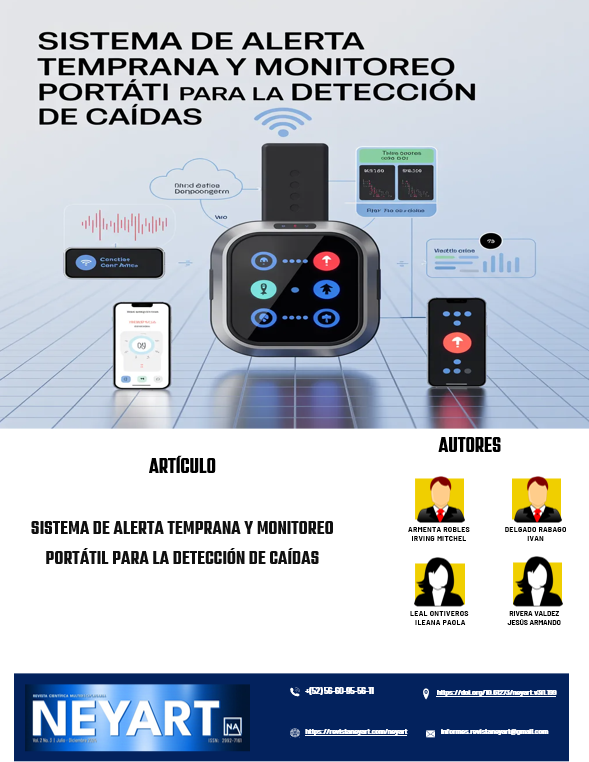
Early warning and portable monitoring system for fall detection
DOI:
https://doi.org/10.61273/neyart.v4i1.199Keywords:
IoT, Fall detection, Elderly, Wearable, ESP32Abstract
Falls in the elderly represent a serious risk to the population, being the main cause of loss of autonomy and severe injuries. To mitigate the consequences of these accidents through timely intervention, this paper presents the development and validation of a portable early warning and monitoring system for fall detection. The device integrates a microcontroller and an inertial sensor, using an acceleration threshold-based algorithm calibrated experimentally. The methodology integrates laboratory tests and a functional validation in a real-world scenario. Results demonstrate that the system has achieved a TRL 5 maturity level, reaching a false positive rate of 0 during daily activity validation and an average alert transmission time of 4.02 seconds. It is concluded that the architecture establishes a robust and effective solution for remote assistance, ensuring the notification of critical events.
Downloads
Metrics
References
Aakesh, U., Rajasekaran, Y., Sabarivani, & Sudhakar, T. (2023). Review on Healthcare Monitoring and Tracking Wristband for Elderly People using ESP-32. En 2023 5th International Conference on Smart Systems and Inventive Technology (ICSSIT) (pp. 523-529). IEEE. https://doi.org/10.1109/ICSSIT55814.2023.10061134
Álvarez Rodríguez, F. J., Luna García, H., & Mendoza González, R. (2015). Patrones de diseño para mejorar la accesibilidad y uso de aplicaciones sociales para adultos mayores. Comunicar, 22(45), 85–94. https://www.revistacomunicar.com/pdf/45/c4509es.pdf
Archundia Sierra, E., Cerón Garnica, C., Cervantes, P., & Rodríguez, F. (2016). Diseño y desarrollo de una aplicación móvil accesible de navegación individual y localización para personas de la tercera edad con discapacidad visual. Research in Computing Science, (126), 109–119.
Efendi, A., Ammarullah, M. I., Isa, I. G. T., Sari, M. P., Izza, J. N., Nugroho, Y. S., Nasrullah, H., & Alfian, D. (2025). IoT-Based Elderly Health Monitoring System Using Firebase Cloud Computing. Health Science Reports, 8(1), e70498. https://doi.org/10.1002/hsr2.70498
Estrada Marmolejo, R., & Moran Garabito, C. E. (2017). Algoritmo de detección de caídas en un sistema embebido [Tesis de Maestría]. Centro de Tecnología Avanzada (CIATEQ). Repositorio Institucional CIATEQ. https://ciateq.repositorioinstitucional.mx/jspui/bitstream/1020/89/1/MoranGarabitoCarlosE%20MSIM%202017.pdf
Giuffrida, D., Benetti, G., De Martini, D., & Facchinetti, T. (2019). Detección de caídas con aprendizaje automático supervisado utilizando sensores portátiles. En IEEE 17th International Conference on Industrial Informatics (INDIN) (pp. 253-259). IEEE. https://doi.org/10.1109/INDIN41052.2019.8972246
INEGI. (2023). Encuesta Nacional de la Dinámica Demográfica (ENADID). Instituto Nacional de Estadística y Geografía. https://www.inegi.org.mx/programas/enadid/2023/
Martínez Méndez, R., & Romero Huertas, M. (2013). Uso de sensores inerciales en la medición y evaluación del movimiento humano para aplicaciones en la salud. Revista Ideas en Ciencia, (37), 9-18. https://www.researchgate.net/publication/263198667_Uso_de_sensores_inerciales_en_la_medicion_y_evaluacion_de_movimiento_humano_para_aplicaciones_en_la_salud
Organización Mundial de la Salud. (2021, 26 de abril). Caídas. Organización Mundial de la Salud. https://www.who.int/es/news-room/fact-sheets/detail/falls
Ribeiro, O., Gomes, L., & Vale, Z. (2022). IoT-Based Human Fall Detection System: Architecture, Protocols, and Applications. Electronics, 11(4), 592. https://doi.org/10.3390/electronics11040592
Rybenská, K., Knapová, L., Janiš, K., Kühnová, J., Cimler, R., & Elavsky, S. (2024). Tecnologías SMART en el cuidado de adultos mayores: una revisión de exploración y guía para los cuidadores. Revista de Tecnologías Habilitantes, 18(4), 200–222. https://doi.org/10.1108/JET-05-2023-0016
Sharma, N., Brinke, J., Gemert-Pijnen, J., & Braakman-Jansen, L. (2021). Implementation of Unobtrusive Sensing Systems for Older Adult Care: Scoping Review. JMIR Aging, 4(4), e27862. https://doi.org/10.2196/27862
Shibuya, N., et al. (2015). A real-time fall detection system using a wearable gait analysis sensor and a Support Vector Machine (SVM) classifier. En 2015 Eighth International Conference on Mobile Computing and Ubiquitous Networking (ICMU) (pp. 66-67). IEEE. https://doi.org/10.1109/ICMU.2015.7061032
Wild, K., Boise, L., Lundell, J., & Foucek, A. (2008). Monitoreo discreto en el hogar de la salud cognitiva y física: reacciones y percepciones de adultos mayores. Journal of Applied Gerontology, 27(2), 181-200. https://doi.org/10.1177/0733464807311435
Zhang, J., Li, J., & Wang, W. (2021). A Class-Imbalanced Deep Learning Fall Detection Algorithm Using Wearable Sensors. Sensors, 21(19), 6511. https://doi.org/10.3390/s21196511