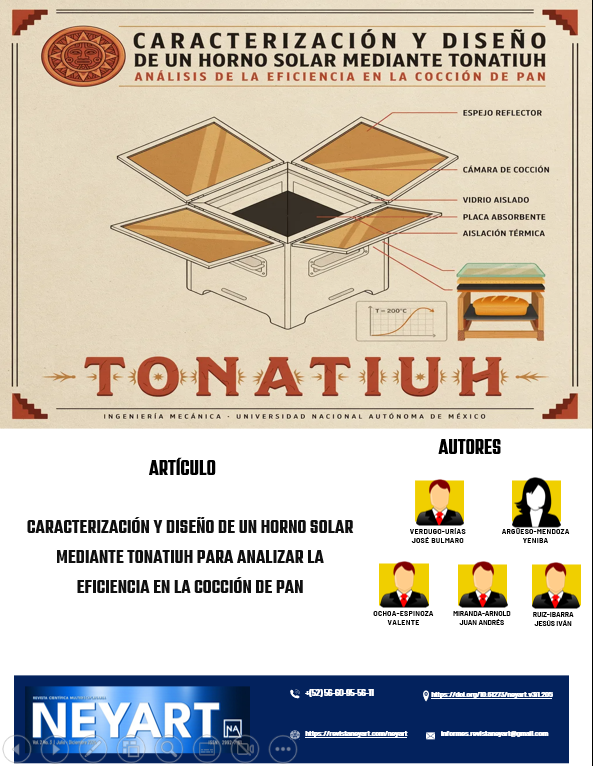
Characterization and design of a solar oven using Tonatiuh for evaluating baking efficiency
DOI:
https://doi.org/10.61273/neyart.v4i1.206Keywords:
Bread baking, solar energy, solar oven, Tonatiuh software.Abstract
This project focuses on the characterization and design of a solar oven that uses a satellite dish as a concentrator, with specifications of 70 cm in diameter, 61.25 cm in focal length and 5 cm in depth. The tests included the design of a planar heliostat with a solar tracker (configured as a square of dimensions Side x Side) and the estimation of the radiant flux distribution and the maximum power obtained on a circular target of 20 cm in diameter located in the distance focal. A parametric analysis was performed to evaluate how the position of the objective with respect to the focal length (slant range), the size of the receiver (diameter), the zenith angle and the percentage of reflectivity of the concentrator affect the efficiency of the furnace in terms of power (Watts), as well as the maximum power obtained in the different 4 seasons (solstices or equinoxes) of the year 2024. Tests were also carried out without the use of a heliostat, analyzing the effect of direct solar radiation on the design from the oven. The results indicate that the maximum power on the 20 cm diameter target is 312 Watts with the heliostat and 332 Watts without the heliostat. The estimates were made using the open source ray tracing software "Tonatiuh".
Downloads
Metrics
References
Blanco, M. (2018). Tonatiuh: An object oriented, distributed computing, Monte-Carlo ray tracer for the design and simulation of solar concentrating systems. University of Texas at Brownsville, (pp.1-2). https://www.researchgate.net/publication/237256255_Tonatiuh_An_object_oriented_distributed_computing_Monte-Carlo_ray_tracer_for_the_design_and_simulation_of_solar_concentrating_systems
Canales, B. (2022). CARACTERIZACIÓN DE GEOMETRÍAS DE CONCENTRACIÓN SOLAR UTILIZANDO MODELOS DE TRAZADO DE RAYOS. Universidad de Chile. https://repositorio.uchile.cl/handle/2250/186634
CENER. (2017). Tonatiuh. https://github.com/iat-cener/tonatiuh
CEPAL. (2022). El mundo alcanza los 8 mil millones de habitantes, de los cuales 662 millones viven en América Latina y el Caribe. Naciones Unidas. https://www.cepal.org/es/noticias/mundo-alcanza-8-mil-millones-habitantes-cuales-662-millones-viven-america-latina-caribe
Del Río, J., Tapia, S., y Jaramillo, O. (2010). Cocedores solares. Revista digital universitaria .Centro de Investigación en Energía-Universidad Nacional Autónoma de México, Vol.11(No.10), p.4. https://www.revista.unam.mx/vol.11/num10/art93/art93.pdf
Esteves, A., Buenanueva, F., y Cavagnaro, L. (2006). PASTEURIZACION DE LECHE UTILIZANDO UN HORNO SOLAR (Vol. 10). (A. e. Ambiente, Ed.) Argentina: ASADES. https://ri.conicet.gov.ar/bitstream/handle/11336/40499/CONICET_Digital_Nro.f941ff90-f645-4f62-9320-827b800b311b_A.pdf?sequence=2&isAllowed=y
Flores, V., Sánchez, M., Bedolla, J., y Bedolla, H. (2021). Concentración y distribución de radiación solar en el receptor de un concentrador de disco parabólico. MEMORIAS DEL XXVII CONGRESO INTERNACIONAL ANUAL DE LA SOMIM. https://somim.org.mx/memorias/memorias2021/articulos/A4_37.pdf
Gastronomía Solar. (2023). Horno solar. España. https://gastronomiasolar.com/horno-solar/
González, M., López, L., Servín, H., y González, D. (2014). ESTUDIO DE PROPIEDADES TÉRMICAS DEL HORNO SOLAR TOLOKATZIN . Juriquilla, Querétaro, México: MEMORIAS DEL XX CONGRESO INTERNACIONAL ANUAL DE LA SOMIM. https://www.researchgate.net/publication/317078518_ESTUDIO_DE_PROPIEDADES_TERMICAS_DEL_HORNO_SOLAR_TOLOKATZIN
Marín, J. (2017). Estudio de implantación y modelado de un pequeño horno solar en Tonatiuh. Universidad de Sevilla. https://biblus.us.es/bibing/proyectos/abreproy/91100/fichero/TFG+JLMG.pdf
NACIONES UNIDAS. (2018). La Agenda 2030 y los Objetivos de Desarrollo Sostenible: una oportunidad para América Latina y el Caribe . NAciones Unidas, Santiago: Publicación de las Naciones Unidas. https://repositorio.cepal.org/server/api/core/bitstreams/cb30a4de-7d87-4e79-8e7a-ad5279038718/content
Roulet, E. (2010). La cocina solar. DESDE LA PATAGONIA DIFUNDIENDO SABERES, Vol. 7(No.10). https://desdelapatagonia.uncoma.edu.ar/wp-content/uploads/2019/01/4.-Revista-N10_Roulet.pdf
Sánchez, F. (2016). Diseño y análisis de un pequeño horno solar con Tonatiuh. Universidad de Sevilla. https://idus.us.es/server/api/core/bitstreams/b924edfb-f798-49d6-ae89-5174f6f7ce2c/content
Sosa, P. (2015). DESARROLLO DE UNA METODOLOGÍA PARA EL DISEÑO Y CARACTERIZACIÓN DE UN HORNO SOLAR CENTRADO EN EL EJE CON CAPACIDAD TÉRMICA DE 1KW. UNIVERSIDAD DE SONORA. DIVISIÓN DE INGENIERÍA. https://concentracionsolar.org.mx/images/pdf/tesis/m2_pablo_sosa_corregida.pdf
World Wildflife Fund. (2022). Informe planeta vivo 2022: Hacia una sociedad con la naturaleza en positivo. Almond, pp.67-69. https://wwflpr.awsassets.panda.org/downloads/descarga_informe_planeta_vivo_2022_1_1_1.pdf