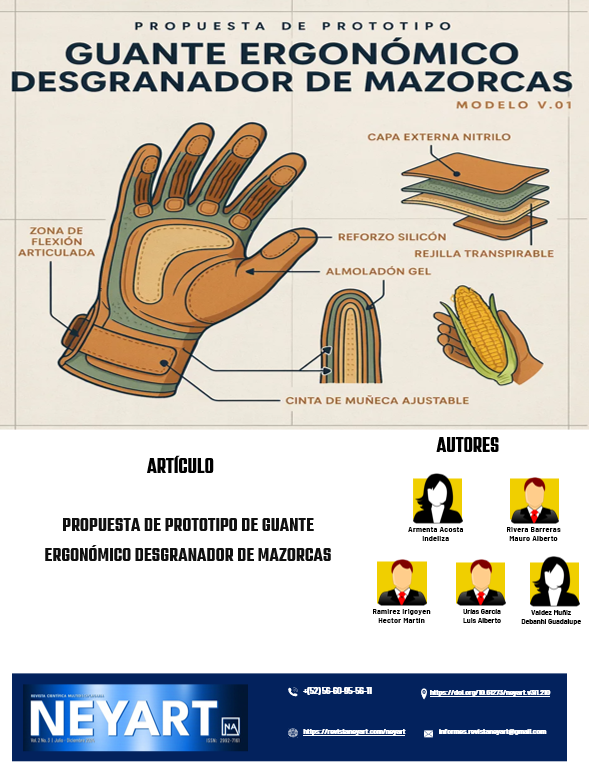
Proposal for prototype of ergonomic glove shelling cob shammer
DOI:
https://doi.org/10.61273/neyart.v4i1.210Keywords:
Anthropometry, shelling, ergonomics, fatigue, gloves, hand tools, corn cobs, repetitive movements, prototype, injuries, effort reductionAbstract
This project aims to design and develop an ergonomic glove whose primary objective is to facilitate the manual shelling of corn cobs. It is focused mainly on small-scale agricultural producers in the northern region of Sinaloa, Mexico—a key area for corn production—where many people perform this activity for commercialization or self-consumption. Traditional shelling methods are used, but the conventional manual shelling process is highly intensive, slow, and exhausting. As a result, it causes fatigue, muscle injuries, skin lesions, and problems such as tendinitis due to repetitive movements, ultimately leading to low labor efficiency.
The presented study applies principles of ergonomics, anthropometry, and design, which provide essential guidance for the glove manufacturing process.
The main objective is to design an ergonomic glove tailored to the anthropometric measurements of producers in northern Sinaloa. The prototype features rounded and reinforced chain links that are securely attached using Plasti-Steel adhesive to facilitate corn cob shelling. This design focuses on minimizing physical effort, reducing the risk of injuries, and improving efficiency compared to the traditional methods currently used by small producers in northern Sinaloa. The prototype glove, based on local anthropometric studies, was developed considering the 0.5 and 0.9 percentiles (hand length 15–18 cm, palm width 9–11 cm, etc.) to ensure a wide, comfortable fit for both men and women.
The project is viable because it directly addresses fatigue and injuries that affect health and productivity. Existing tools are neither ergonomic nor accessible (mechanical options are expensive), while the anthropometric design improves working conditions, promotes sustainability, and respects traditional agricultural practices.
The project demonstrates high viability from a technical perspective (using locally available low-cost materials: size 7 and 9 gloves, stainless steel chain, Plasti-Steel adhesive; simple process easily replicable in rural settings), economic perspective (low production costs and savings in health and labor time), practical perspective (intuitive downward-motion use and high durability), and social perspective (strong community acceptance and improved quality of life).
Surveys were conducted with 15 producers: 100% use manual methods, 92% experience pain or fatigue, and there is high willingness to adopt the glove at an average acceptable cost of approximately $300 MXN.
The prototype glove, utilizing 8×12 mm chain links and implementing a downward movement technique for manual shelling, was tested with users who reported experiencing significantly less fatigue, reduced pain (especially in the hands and wrists), greater efficiency, improved safety, and enhanced comfort during their work.
Suggested improvements include using smaller-dimension chain links, adding a leather surface to the palm, reinforcing the seams that secure the links, and avoiding the use of Plasti-Steel for link reinforcement.
100% of users reported significant benefits when using the prototype glove
Downloads
Metrics
References
Abdulkadir, L. B. (2018). Desarrollo de una máquina descascarilladora de maíz con unidad de soplado. Actas de la Conferencia Anual de SEET-FUTA 2018, 1-10. https://www.researchgate.net/publication/326456789
Acosta, C. R. (2009). El cultivo de maíz. Cultivos Tropicales, 1, 54-71. http://scielo.sld.cu/scielo.php?pid=S025859362009000200016&script=sci_arttext
Adetunji, O. R. (2018). Diseño y evaluación del rendimiento de una desgranadora de maíz para pequeños agricultores. MOJ Applied Bionics and Biomechanics, 2(5), 1-7. https://medcraveonline.com/MOABB/MOABB-02-00045.pdf
Adewumi, B. A. (2007). Evaluación ergonómica de las operaciones manuales de desgranado de maíz. Revista de Seguridad y Salud Agrícola, 13(2), 167-175. https://doi.org/10.13031/2013.22614
Attanda, M. L. (2018). Evaluación del rendimiento de una descascaradora de maíz estacionaria motorizada. Revista de Ciencia y Tecnología Agrícola, 8(2), 123-135. https://www.davidpublisher.com/index.php/Home/Article/index?id=36892.html
Bigland-Ritchie, B., y Woods, J. J. (1984). Cambios en las propiedades contráctiles musculares y el control neural durante la fatiga muscular humana. Muscle & Nerve, 691-699. https://doi.org/10.1002/mus.880070902
Celibrado, A. (2020). Descascarilladora de maíz (Zea mays) a pequeña escala. Revista Internacional de Investigación Científica y Desarrollo de Ingeniería, 3(6), 102-110. https://www.academia.edu/44867890
Eze, C. C. (2016). Evaluación fisiológica del desgranado manual de maíz en zonas rurales de Nigeria. Revista Internacional de Ingeniería Agrícola y Biológica, 9(4), 89-96. https://www.ijabe.org/index.php/ijabe/article/view/1895
Gandevia, S. C. (2001). Factores espinales y supraespinales en la fatiga muscular humana. Physiological Reviews, 81, 1725-1789. https://doi.org/10.1152/physrev.2001.81.4.1725
García, M., y López, R. (2020). Herramientas ergonómicas para la agricultura sostenible: Un estudio de caso en países en desarrollo. Sustainability, 12(18), 12-34. https://doi.org/10.3390/su12181234
Gupta, R. K. (2013). Diseño ergonómico de una desgranadora de maíz manual para pequeños agricultores. Revista de Ingeniería Agrícola, 50(1), 34-40. https://www.isae.in/journal
Kanannavar, P. S. (2020). Evaluación fisiológica de diferentes métodos manuales de desgranado de maíz. Revista Electrónica SSRN, 1-12. https://doi.org/10.2139/ssrn.3594221
Karikatti, S. R. (2015). Desgranadora de maíz operada por manivela. Revista Internacional de Ingeniería Agrícola, 8(1), 45-50. https://www.researchgate.net/publication/283506789
Kumar, D. (2016). Evaluación ergonómica de una desgranadora de maíz operada manualmente. Revista de Ergonomía, 6(3), 1-6. https://www.omicsonline.org/open-access/ergonomic-evaluación-of-manually-operated-maize-sheller-2165-7556-1000163.pdf
Mehta, C. R., y Tewari, V. K. (2020). Intervenciones ergonómicas en la agricultura a pequeña escala: Una revisión sistemática. Revista de Salud Ocupacional, 62. https://doi.org/10.1002/1341-9145.12123
Miu, P. (2013). Técnicas manuales de desgranado de maíz: Una revisión de prácticas tradicionales. Ingeniería Agrícola Internacional: Revista CIGR, 15(2), 78-85. https://cigrjournal.org/index.php/Ejounral/article/view/2456
Muñoz, R. (1989). Agricultura técnica. Estación Experimental La Platina, 1, 143-147. https://oes.chileanjar.cl/files/V50I2A08_es.pdf
Nwakuba, N. R. (2020). Optimización de los parámetros operativos de una desgranadora de maíz mejorada mediante la metodología de superficie de respuesta. Revista de Ciencia y Tecnología Agrícola, 10(3), 145-156. https://www.davidpublisher.com/index.php/Home/Article/index?id=43678.html
Ogaji, S. (2006). Desgranadora de maíz de flujo continuo accionada manualmente. Revista de Ingeniería y Tecnología Agrícola, 14(1), 23-28. https://www.academia.edu/4486789
Ojomo, A. O. (2016). Desarrollo de una desgranadora de maíz sencilla para mujeres rurales. Revista de Agricultura Sostenible y Medio Ambiente, 2(1), 12-18. https://www.researchgate.net/publication/305695789
Olaoye, J. O. (2011). Diseño y construcción de una desgranadora de maíz operada manualmente. Revista de Investigación en Ingeniería y Tecnología, 3(8), 228-234. https://academicjournals.org/journal/JETR/article-full-text-pdf/8A8C5E52947
Olukunle, O. J. (2010). Desarrollo de una desgranadora de maíz de bajo costo para agricultores rurales. Revista de Ingeniería y Tecnología Agrícola, 18(2), 45-53. https://www.niae.net/publications/jaet
Oluwole, F. A. (2015). Diseño y fabricación de una desgranadora de maíz manual a pequeña escala. Revista Internacional de Investigación en Ingeniería y Tecnología, 4(9), 456-461. https://www.ijert.org/download/14132
Pérez, J., Cholca, L., y Mantilla, G. (2017). Diseño y fabricación de una máquina para desgranar maíz. Ingenio, 18, 21-29. https://www.redalyc.org/journal/xxxx/xxxxx/
Prado Martínez, M., Anzaldo Hernández, J., Becerra Aguilar, B., Palacios Juárez, H., Vargas Radillo, J. de J., y Rentería Urquiza, M. (2012). Caracterización de hojas de mazorca de maíz y de bagazo de caña para la elaboración de una pulpa celulósica mixta. Madera y Bosques, XVIII(3), 37-51. https://www.scielo.org.mx/scielo.php?script=sci_arttext&pid=S1405-04712012000300004
Ramos, J. A., Ramírez, A., Luna, C., Arizmendi, I., y Castillo, L. (2022). Estudio comparativo de sistemas de desgranado de maíz, en base a criterios de sostenibilidad. Sociedad Mexicana de Ingeniería Mecánica, 1, 10. https://somim.org.mx/memorias/memorias2022/articulos/A9_46.pdf
Rodríguez, A., y Fernández, J. (2020). Innovaciones ergonómicas en la agricultura: Una revisión de los avances recientes. Journal of Ergonomics, 10(2), 123-134. https://doi.org/10.1155/2020/1234567
Sahoo, P. K. (2019). Diseño y desarrollo de un descascarillador de maíz: Una revisión. Revista de Ingeniería Agrícola, 56(2), 89-98. https://www.isae.in/journal
Singh, S. (2020). Desarrollo y evaluación de una desgranadora manual de maíz para pequeños agricultores. Agricultural Engineering International: CIGR Journal, 22(3), 123-134. https://www.cigrjournal.org/index.php/Ejounral/article/view/5678
Sonawane, S. (2022). Investigaciones sobre las propiedades físicas del maíz en el contexto del descascarillado y descascarillado mecánico. The Pharma Innovation Journal, 11(12), 5440-5443. https://www.thepharmajournal.com/archives/2022/vol11issue12/11-12-16-374.pdf