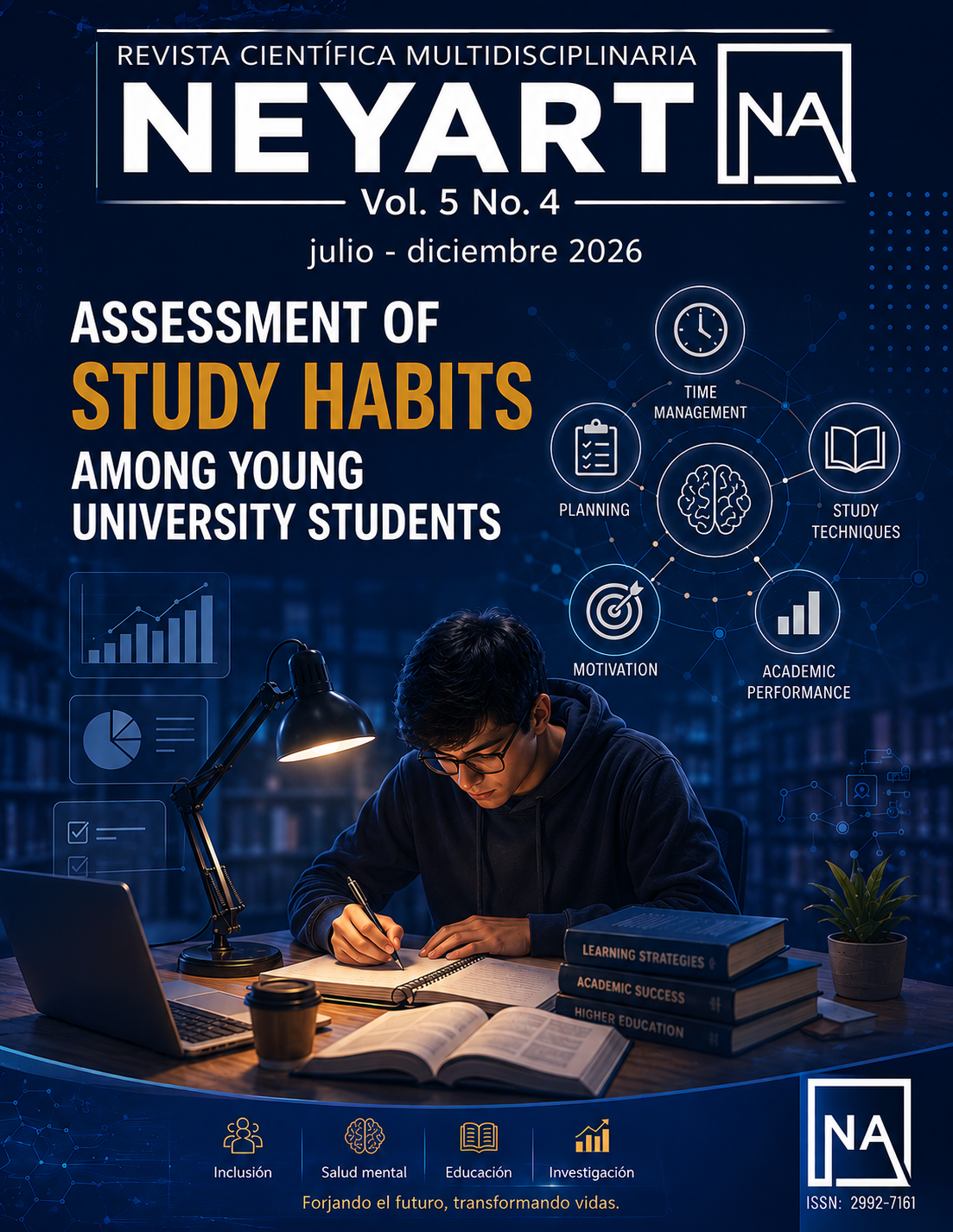
Evaluación de los hábitos de estudio entre los estudiantes universitarios jóvenes
DOI:
https://doi.org/10.61273/neyart.v4i4.212Keywords:
pensamiento crítico, formación inicial del profesorado, educación superior, habilidades cognitivas, autorregulación del aprendizajeAbstract
Este estudio evaluó el nivel de pensamiento crítico de 42 estudiantes de primer semestre durante el año académico 2025-I. Esta investigación fue no experimental y cuantitativa, de tipo descriptivo-comparativo y de corte transversal. El instrumento utilizado fue el Cuestionario de Pensamiento Crítico Delgado Garay (2025), el cual consta de 24 ítems agrupados en seis dimensiones, como análisis, inferencia, explicación, interpretación, autorregulación y evaluación. Tuvieron una media de 68.51 (DE = 9.74) en esta medida, ubicándose en el rango bajo-medio en relación con las normas de la escala derivadas de personas de entre 18 y 30 años (puntuación promedio = 77 puntos). Los valores medios para la autorregulación (M = 14.21) estuvieron por encima de todas las demás medias, mientras que el valor simultáneo más bajo se percibió para la interpretación (M = 8.40). De esos, el 83.3 por ciento se ubicó en las categorías Bajo-a-medio o por debajo, y ningún estudiante alcanzó un nivel alto. Los resultados indicaron que las puntuaciones promedio generales para las tres dimensiones de las estudiantes fueron más altas que las de los estudiantes; sin embargo, ninguno de estos resultados, aunque en la dirección esperada, fue estadísticamente significativo.
Downloads
Metrics
References
Betancourth-Zambrano, S., Muñoz-Moran, T., & Rosas-Lagos, J. (2017). Assessment of critical thinking in higher education students in the Atacama region of Chile. Prospectiva, (23), 199–223. https://doi.org/10.25100/prts.v0i23.4594
Betancourth Zambrano, S., Tabares Díaz, Y., & Martínez Daza, V. (2020). Intervention program on critical debate regarding critical thinking among university students. Education and Humanism, 22(38), 1–17. https://doi.org/10.17081/eduhum.22.38.3577
Betancourth Zambrano, S., Tabares Díaz, Y. A., & Díaz Muñoz, E. P. (2024). Assessment of critical thinking among university students in southwestern Colombia. Revista Virtual Universidad Católica del Norte, (72), 96–127. https://doi.org/10.35575/rvucn.n72a5
Betancourth Zambrano, S., Zambrano Guerrero, C., & Ceballos Mora, A. (2022). Adapted critical thinking scale for university students in Colombia, Mexico, and Chile. Journal of Education, 13(25), 157–174. https://fh.mdp.edu.ar/revistas/index.php/r_educ/article/view/5836
Bezanilla-Albisua, M. J., Fernández-Nogueira, D., Poblete-Ruiz, M., & Galindo-Domínguez, H. (2019). Methodologies for teaching-learning critical thinking in higher education: The teacher's view. Thinking Skills and Creativity, 33, 100584. https://doi.org/10.1016/j.tsc.2019.100584
Bezanilla-Albisua, M. J., Galindo-Domínguez, H., & Poblete-Ruiz, M. (2021). Importance of teaching critical thinking in higher education and existing difficulties according to teachers' views. Multidisciplinary Journal of Educational Research, 11(1), 20–48. https://doi.org/10.17583/remie.0.6159
Breakstone, J., McGrew, S., Smith, M., Ortega, T., & Wineburg, S. (2021). Why we need a new approach to teaching digital literacy. Phi Delta Kappan, 102(8), 27–32. https://doi.org/10.1177/0031721721998898
Canese de Estigarribia, M. I. (2020). Perception of the development of critical thinking skills at the National University of Asunción, Paraguay. Perfiles Educativos, 42(169), 8–24. https://doi.org/10.22201/iisue.24486167e.2020.169.59295
Cangalaya Sevillano, L. M. (2020). Critical thinking skills in university students through research. Desde el Sur, 12(1), 141–153. https://doi.org/10.21142/des-1201-2020-0009
Delgado Garay, E. K. (2025). Critical thinking and academic performance among students at the San Francisco de Asís Public Higher Pedagogical Education School. Ica [Master’s thesis, Enrique Guzmán y Valle National University of Education]. UNE Institutional Repository.
Enríquez Canto, Y., Zapater Ferrer, E., & Díaz Gervasi, G. M. (2021). Disposition, critical thinking skills, and academic success in college students: a meta-analysis. Revista Complutense de Educación, 32(4), 525–536. https://doi.org/10.5209/rced.70748
Galindo-Domínguez, H., Bezanilla, M.-J., Campo, L., Fernández-Nogueira, D., & Poblete, M. (2023). A teacher-based approach to assessing the perception of critical thinking in education university students based on their age and gender. Frontiers in Education, 8, 1127705. https://doi.org/10.3389/feduc.2023.1127705
Hernández-Sampieri, R., & Mendoza Torres, C. P. (2018). Research Methodology: Quantitative, Qualitative, and Mixed Methods. McGraw-Hill Education. https://virtual.cuautitlan.unam.mx/rudics/?p=2612
Hyytinen, H., Jämsä, M., Tuononen, T., & Kleemola, K. (2025). A systematic-narrative review of performance-based assessments of critical thinking in higher education. Assessment & Evaluation in Higher Education. Published online ahead of print. https://doi.org/10.1080/02602938.2025.2553341
Liu, O. L., Frankel, L., & Roohr, K. C. (2014). Assessing critical thinking in higher education: Current state and directions for next-generation assessment. ETS Research Report Series, 2014(1), 1–23. https://doi.org/10.1002/ets2.12009
Ñaupas Paitán, H., Valdivia Dueñas, M. R., Palacios Vilela, J. J., & Romero Delgado, H. E. (2018). Quantitative-Qualitative Research Methodology and Thesis Writing (5th ed.). University of https://books.google.com/books?id=KzSjDwAAQBAJ
Rivas, S. F., & Saiz, C. (2012). Validation and psychometric properties of the PENCRISAL critical thinking test. Electronic Journal of Applied Methodology, 17(1), 18–34. https://doi.org/10.17811/rema.17.1.2012.18-34
Rivas, S. F., Franco, A., Vieira, R. M., Almeida, L. S., & Saiz, C. (2023). Assessing higher education students' critical thinking with the PENCRISAL test – Portuguese short version: A psychometric study. Frontiers in Psychology, 14, 1196794. https://doi.org/10.3389/fpsyg.2023.1196794