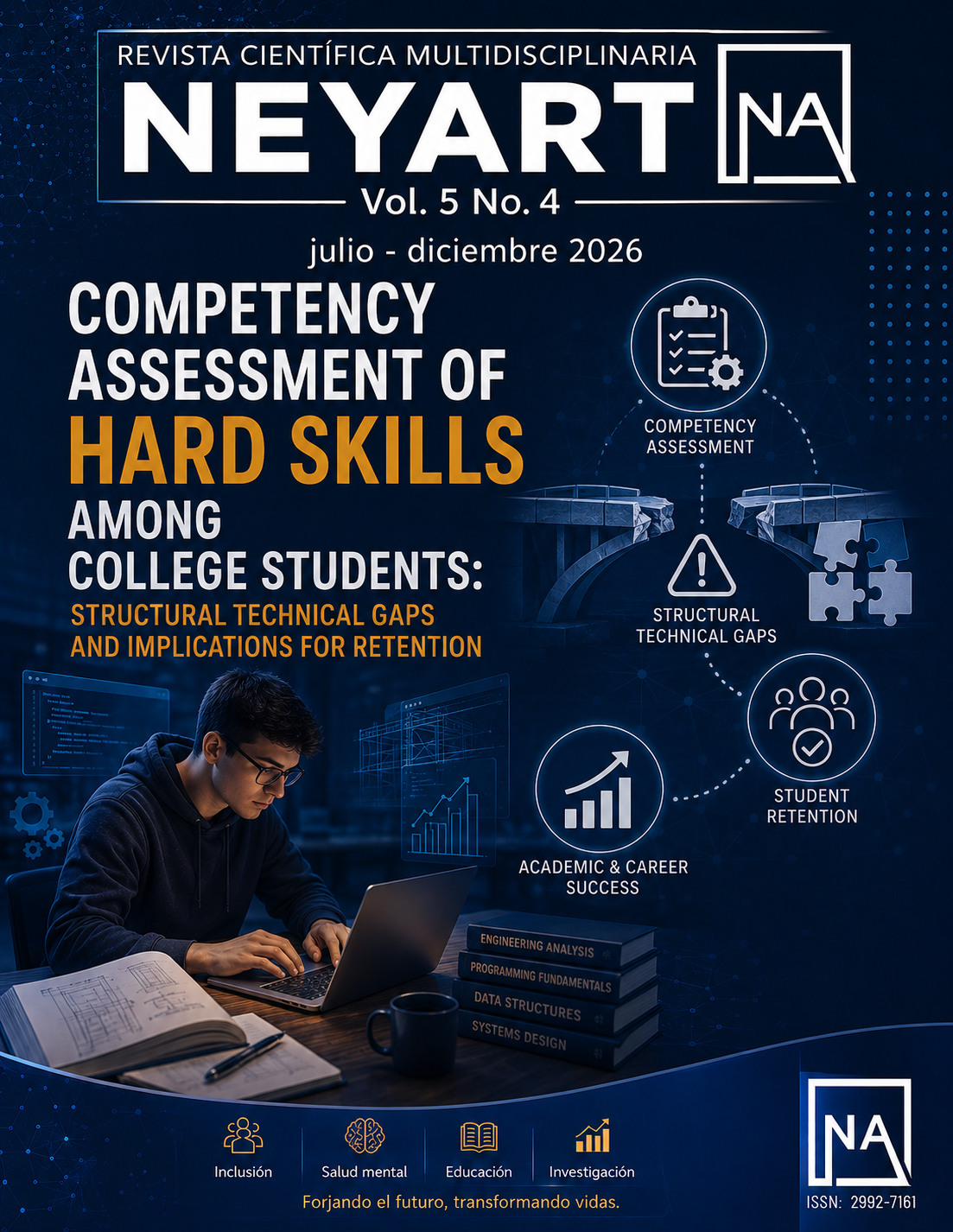
Diagnóstico competencial de habilidades duras en universitarios: brechas técnicas estructurales e implicaciones en retención escolar
DOI:
https://doi.org/10.61273/neyart.v4i4.213Keywords:
Competencias técnicas, Diagnóstico educativo, Educación superior, Habilidades duras, Rezago escolarAbstract
Esta investigación evaluó el grado de dominio de las habilidades técnicas en estudiantes universitarios del primer semestre (N=48) durante el mismo periodo de agosto a diciembre de 2025. La adaptación de los bloques instrumentales a las Escalas de Observación Conductual fue un enfoque cuantitativo y una base trasplantada para un diseño diagnóstico-descriptivo transversal de origen. Los resultados estadísticos indicaron un desempeño global predominantemente intermedio-bajo, como lo señala una media global ponderada de 2.18. La dimensión de resolución técnica de problemas fue la que apareció como la que presentaba más déficit en el diagnóstico, con un promedio de 1.85, marcando una clara incapacidad para estructurar secuencialmente soluciones ante fallas lógicas. Mientras tanto, las habilidades básicas de informática obtuvieron la puntuación más baja entre el rezago con un valor de 2.41, lo que implica únicamente poder realizar tareas simples al respecto. Asimismo, encontramos que no hubo brechas sustanciales en el desempeño instrumental con respecto al sexo. Se concluye que los alumnos de nuevo ingreso carecen de las destrezas técnicas mínimas requeridas en la educación superior, haciendo indispensable la implementación urgente de programas remediales obligatorios orientados a mitigar estas brechas cognitivas estructurales y asegurar la retención escolar temprana.
Downloads
Metrics
References
Aguado, D., González, A., Antúnez, M., & de Dios, T. (2017). Assessment of transferable skills among college students. Initial psychometric properties of the Transferable Skills Questionnaire. REICE. Ibero-American Journal on Quality, Effectiveness, and Change in Education, 15(2), 129–152. https://doi.org/10.15366/reice2017.15.2.007
Asonitou, S. (2022). Measuring the gap between academic hard skills training and modern industry demands in higher education. Higher Education, Skills and Work-Based Learning, 12(3), 455-472. https://doi.org/10.1108/HESWBL-05-2021-0098
Asonitou, S. (2022). The digital transformation era: Redefining technical mastery and soft skills in higher education. European Journal of Higher Education, 12(3), 289-305.
García-Vargas, M., López-Maldonado, J., & Restrepo, A. (2022). Gaps in technical training upon entry into higher education in Latin America. Ibero-American Journal of Higher Education, 13(36), 88-105. https://doi.org/10.22201/iisue.20072872e.2022.36.1192
He, T., Zhang, L., & Chang, Y. (2021). The definitive role of hard skills in early engineering employment outcomes. Journal of Engineering Education Research, 29(2), 114-129. https://doi.org/10.1016/j.jeer.2021.02.004
Jones, P., & Broadbent, M. (2020). OECD metrics and the standardization of technical competencies in global higher education. Educational Evaluation Policy Analysis, 42(4), 567-584. https://doi.org/10.3102/0162373720934521
Martínez-Sánchez, F., & Rodríguez, C. (2023). Technical competencies and professional qualification frameworks in Mexican higher education. Journal of Higher Education, 52(206), 45-63. https://doi.org/10.36857/resu.2023.206.2415
Pérez-Franco, J. (2021). Structural challenges in the assessment of disciplinary skills in the Southern Cone. Quality in Education, (54), 112–139. https://doi.org/10.31619/caledu.n54.968
Ramírez, G., & González, E. (2023). Digital literacy and diagnostic quantitative skills among first-year students. Apertura, 15(1), 34–49. https://doi.org/10.32870/Ap.v15n1.2301
Silva, M., & Santos, R. (2022). Gender gaps in the self-perception of hard technological skills among college students. Latin American Journal of Educational Technology, 21(2), 75-91. https://doi.org/10.17398/1695-288X.21.2.75
Smith, J., & Martínez, K. (2023). Quantitative deficiencies in first-year university students and their correlation with retention. Journal of College Student Retention: Research, Theory & Practice, 25(1), 142-161. https://doi.org/10.1177/15210251211011342
Torres-Cáceres, L. (2024). The disconnect between hard academic skills and Latin American SMEs. Estudios Gerenciales, 40(170), 89-102. https://doi.org/10.18046/j.estger.2024.170.6120
Tymon, A. (2021). The 4.0 Industry Paradigm: Redefining Technical Mastery Within Academic Structures. Studies in Higher Education, 46(8), 1611-1624. https://doi.org/10.1080/03075079.2019.1698532
Valencia-Maldonado, G. (2023). Diagnostic competency-based assessment in Andean higher education. Formación Universitaria, 16(3), 55-66. https://doi.org/10.4067/S0718-50062023000300055
Wilson, H., & Taylor, S. (2022). Objective performance testing vs. self-assessment of technical instrument skills in freshmen. Assessment & Evaluation in Higher Education, 47(5), 789-804. https://doi.org/10.1080/02602938.2021.1963452
Zhao, Q., & Wang, Y. (2024). Technological hard skills entry requirements and academic adaptations in STEM fields. International Journal of Educational Research, 123, 102-117. https://doi.org/10.1016/j.ijer.2023.102117