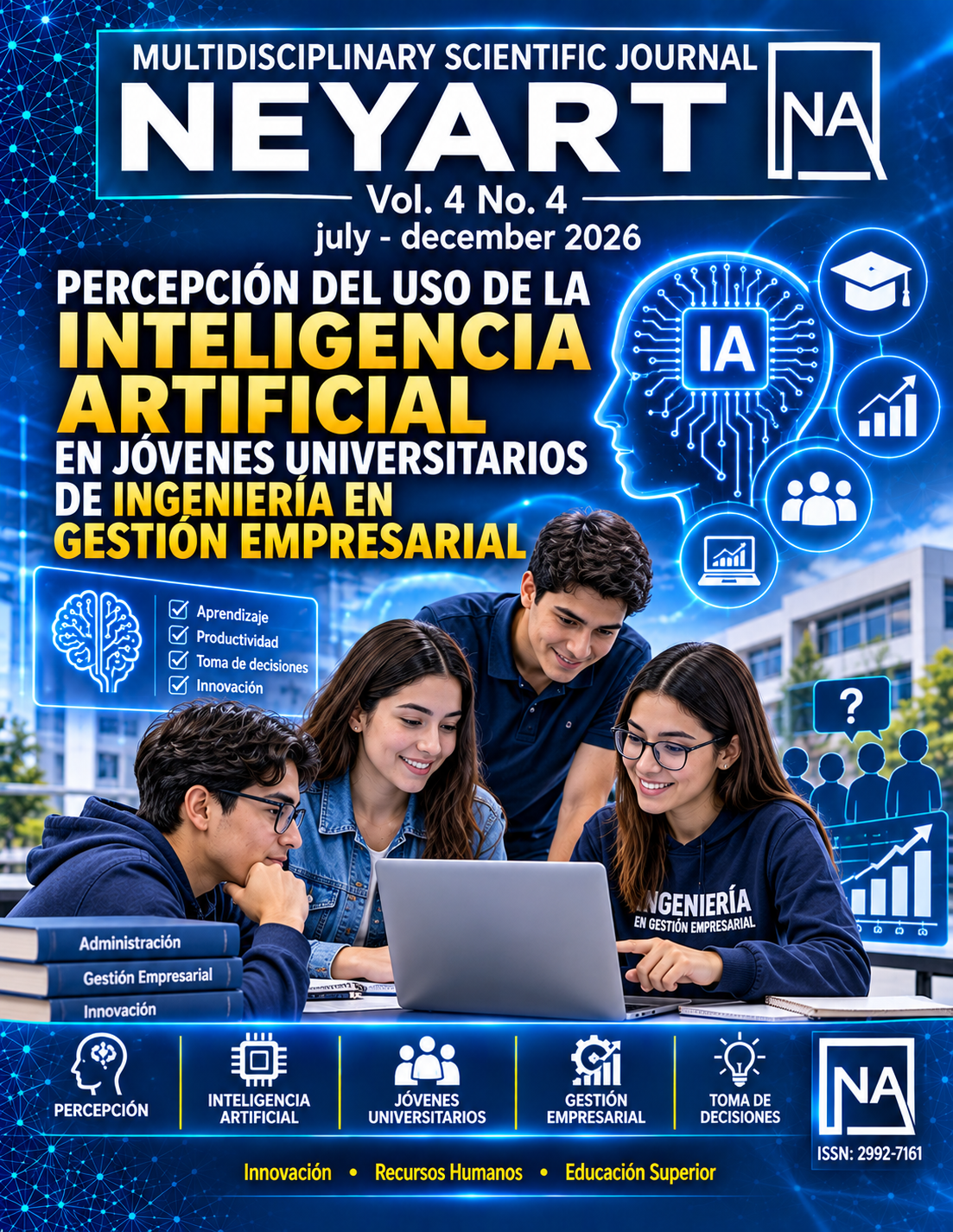
Perceptions of artificial intelligence use among young university students majoring in business management engineering
DOI:
https://doi.org/10.61273/neyart.v4i4.242Keywords:
Higher Education, Students, Ethics, Artificial Intelligence, Information TechnologyAbstract
This study examines students’ perceptions of AI use among a cohort of 26 first-year Business Management Engineering students. An analytical method and a descriptive-correlational cross-sectional design (proportional sampling) were used to administer a questionnaire with Likert-scale questions, measuring overall perceived usefulness by company size, frequency of use, and perceptions of intentionality among companies, while also considering ethical aspects; however, demographic variables were not examined.
The findings revealed a low overall positive score, indicating an early and sporadic adoption characterized by caution. The average score for perceived usefulness was the highest, while low scores were obtained for frequency of use and purposeful use. Similarly, the comparative analysis showed no significant differences between participants of different genders.
It was found that there is still a gap between the digital skills students bring with them when they enter school and what we observe in current practice. Consequently, the findings point to the immediate need for precise ethical codes and systemic efforts to incorporate AI into the academic curriculum.
Downloads
Metrics
References
Akgun, A. E., & Green, R. (2024). Generative artificial intelligence and student creativity in higher education business schools. Computers and Education: Artificial Intelligence, 6, Article 100185. https://doi.org/10.1016/j.caeai.2024.100185
Alarcón, M., Torres, J., & Ramírez, P. (2024). Percepción y adopción de la inteligencia artificial generativa en estudiantes universitarios latinoamericanos. Revista de Educación Superior en la Era Digital, 12(1), 45–68.
Álvarez, D., & Gómez, L. (2023). Inteligencia artificial en la gestión académica: Percepciones y desafíos éticos en universitarios colombianos. Enfoque Educativo, 9(2), 112–130.
Barreto, C., & Silva, M. (2024). Autoeficacia digital y aceptación de sistemas inteligentes en la formación de futuros administradores en Brasil. Revista Latinoamericana de Tecnología Educativa, 23(1), 89–104.
Castillo, R., & Morales, E. (2023). Actitudes de los jóvenes universitarios mexicanos ante la automatización empresarial asistida por inteligencia artificial. Gestión y Tecnología, 15(3), 77–94.
Chen, Y., Zhang, H., & Li, X. (2023). Intelligent tutoring systems in higher education: Student perceptions of personalized learning and academic performance. Computers & Education, 198, Article 104765. https://doi.org/10.1016/j.compedu.2023.104765
Cruz, S., Mendoza, F., & Rojas, K. (2024). Usos éticos y dilemas en torno a la inteligencia artificial en la elaboración de trabajos académicos universitarios. Calidad en la Educación, 58, 201–225.
Dwivedi, Y. K., Kshetri, N., Hughes, L., Slade, E. L., Jeyaraj, A., Kar, A. K., . . . Wright, R. (2023). Opinion paper: “So what if ChatGPT wrote it?” Multidisciplinary perspectives on opportunities, challenges and implications of generative conversational AI for research, practice and policy. International Journal of Information Management, 71, Article 102642. https://doi.org/10.1016/j.ijinfomgt.2023.102642
Fernández, A., & Rojas, M. (2023). Aplicación del modelo TAM en el uso de plataformas adaptativas basadas en IA en Costa Rica. Actualidades Investigativas en Educación, 23(2), 1–28.
García-Peñalvo, F. J., Vázquez-Ingelmo, A., & Conde-González, M. Á. (2023). Percepciones sobre el impacto de ChatGPT en la evaluación universitaria: Retos y oportunidades. Education in the Knowledge Society (EKS), 24, Article e31190. https://doi.org/10.14201/eks.31190
Gómez, J., & Herrera, P. (2024). Impacto psicosocial y confianza en entornos de aprendizaje inteligentes en educación superior. Revista Iberoamericana de Educación a Distancia, 27(1), 145–164.
Hernández, P., Castro, R., & Benítez, M. (2023). Integración curricular de la inteligencia artificial: Desafíos para la formación universitaria en Argentina. Revista Iberoamericana de Educación a Distancia, 26(2), 215–236.
Huang, M. H., & Rust, R. T. (2023). Artificial intelligence in service management: Designing artificial intelligence for strategic business leadership. Journal of Service Research, 26(2), 155–171. https://doi.org/10.1177/10946705221147926
Kallio, J., Nieminen, M., & Virtanen, A. (2024). Data analytics and artificial intelligence acceptance among industrial engineering and management students in Finland. European Journal of Engineering Education, 49(1), 88–104.
Liao, C. H., Huang, Y. S., & Wu, C. Y. (2023). Exploring university students’ continuance intention of generative artificial intelligence services: An empirical study using UTAUT. Computers and Education: Artificial Intelligence, 5, Article 100160. https://doi.org/10.1016/j.caeai.2023.100160
Medina, L., & Vargas, J. (2024). Competencias directivas e inteligencia artificial: Percepciones de empleabilidad en graduados de ingeniería. Innovación Educativa, 24(94), 53–72.
Müller, S., & Strobel, M. (2024). Ethical considerations and algorithmic bias in business decision-making: Student perceptions in German universities. Journal of Business Ethics Education, 21, 45–66.
O’Boyle, N., & Sloan, D. (2023). Transforming engineering and management education for the AI era: Student perspectives and readiness. Higher Education Quarterly, 77(3), 312–328.
Pérez, C., & Domínguez, R. (2023). Aceptación de asistentes conversacionales inteligentes en la simulación de negocios universitarios. Cuadernos de Administración, 39(74), Artículo e22312250.
Wang, L., Chen, K., & Zhang, Y. (2024). AI-driven business simulators in higher education: Enhancing self-efficacy and managerial competencies. Computers & Education, 210, Article 104970. https://doi.org/10.1016/j.compedu.2024.104970