
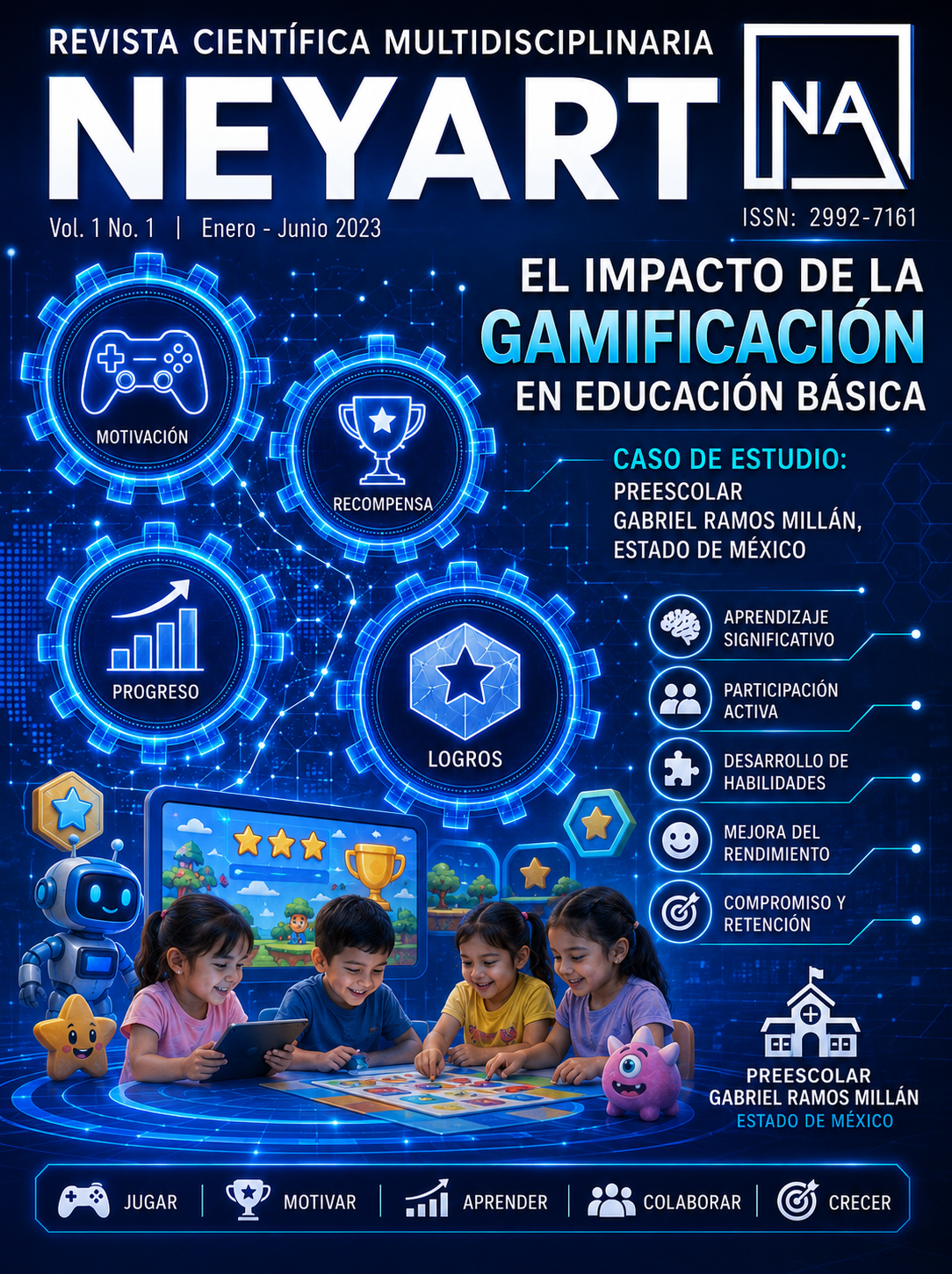
El impacto de la gamificación en educación básica. caso de estudio: Preescolar Gabriel Ramos Millán, Estado de México
DOI:
https://doi.org/10.61273/neyart.v1i1.25Palabras clave:
Tecnologías de la información y comunicación, Tecnologías del aprendizaje y el conocimiento, Gamificación, aprendizaje, enseñanzaResumen
La educación preescolar es considerada la etapa fundamental y primordial en la que los alumnos reciben una educación formal, siendo esta el primer acercamiento después del núcleo familiar, donde transforman los aprendizajes previos que reciben en casa de manera informal para hacer de ellos aprendizajes formales, y durante este proceso se pretende alcanzar un desarrollo íntegro en los niños. Sin embargo, la escuela es considerada un espacio que ofrece áreas de oportunidad en la que los alumnos favorecen competencias y valores que a lo largo del tiempo van potenciando cada vez con mayor gradualidad, así mismo es importante que los docentes, implementen en sus aulas ambientes de aprendizaje armónicos para que los alumnos favorezcan su confianza y
puedan realizar las actividades planteadas.
Dichas actividades, van encaminadas con el uso de la gamificación en la educación preescolar como son las herramientas tecnológicas TIC y TAC, las cuales permiten al docente fortalecer y favorecer los aprendizajes de los alumnos al implementar diversas actividades que representan un desafío para ellos y que logren poner en juego diferentes habilidades para alcanzar los aprendizajes esperados y hacer de esos conocimientos aprendizajes significativos.
Para ello, se implementó una encuesta a 60 participantes del Jardín de Niños Gabriel Ramos Millán para medir el impacto que ha tenido la gamificación en la educación, obteniendo una confiabilidad de 0,92 % de Alfa de Cronbach, siendo confiable debido que las preguntas fueron contestadas en su totalidad, mediante esta implementación se pudo apreciar que el uso de la gamificación tiene una parte fundamental en el proceso de interacción entre el docente y alumno a través del aprendizaje por tal motivo permiten reforzar los aprendizajes esperados que los pequeños han adquirido y ya lo hacen de manera más lúdica, innovadora y sobre todo los niños la realizan con mayor emoción e interés por seguir experimentando.
Descargas
Métricas
Citas
Bojórquez,J. A, López,L., Jiménez,E, yHernández,Ma. E. (2012). Algunas aplicaciones del software Minitab en la materia de estadística aplicada a la ingeniería”, Congreso Lasallista de Educación 2012. ISBN 968-5844-08-9.
Cavazoz Salazar, R. L.,& Torres Flores, S. G. (2016) Diagnóstico del uso de las tecnologías en el proceso de enseñanza y aprendizaje en la educación superior.RIDE. Revista Iberoamericana para la investigación y el desarrollo educativo. 7(13) 273-292 http://www.scielo.org.mx/scielo.php?script=sci_arttext&pid=S2007-74672016000200273&lng=es&tlng=es
Caycho Rodríguez, T.(2017). Intervalos de Confianza para el coeficiente alfa de Cronbach: aportes a la investigación pediátrica. Acta Pediátrica de México, 38(4),291-292.[fecha de Consulta 16 de Septiembre de 2022]. ISSN: 0186-2391. Disponible en: https://www.redalyc.org/articulo.oa?id=423659205011
Chávez Montero, A.(2018).La utilización de una metodología mixta en investigación social. Rompiendo barreras en investigación 2018 (publicado en Colecciones REDES 2017) UTMACH, ed. 1, Recuperado de http://rabida.uhu.es/dspace/handle/10272/15178?show=full
GalindoDomínguez, H. (2020). Estadística Para No Estadisticos Una Guía Básica Sobre La Metodología Cuantitativa De Trabajos Académicos. Área de Innovación y Desarrollo, S.L.
Gonzales Uni, L. (2012) Estrategias para utilizar el uso de las TIC en la práctica docente que mejoren el proceso de aprendizaje. Tesis maestría: https://www.google.com/url?sa=t&source=web&rct=j&url=https://repositorio.tec.mx/handle/11285/571100&ved=2ahUKEwjLl4GQ5LL5AhUVK0QIHbGAAJ0QFnoECAUQAQ&usg=AOvVaw3sFN0yxe8FDcmtucotowUe
Londoño Vásquez, D. A., Muriel Muñoz, L. E.,y Gómez Vahos, L. E. (2019). El papel del docente para el logro de un aprendizaje significativo apoyado en las TIC. Encuentros” [Internet];17(02):118-131. Recuperado de: https://www.redalyc.org/articulo.oa?id=476661510011
Martínez Molina, O. A. (2016).Programa de Formación Docente de las Tecnologías del Aprendizaje y el Conocimiento (Tac) en la Universidad Pedagógica Experimental Libertador Núcleo Barinas (Venezuela). Revista Científica [Internet]. 1(1):90-114. Recuperado de: https://www.redalyc.org/articulo.oa?id=563660226007
Martínez Navarro, G.(2017). Tecnologías y nuevas tendencias en educación: aprender jugando. El caso de Kahoot. Opción, 33(83),252-277.[fecha de Consulta 17 de Septiembre de 2022]. ISSN: 1012-1587. Disponible en: https://www.redalyc.org/articulo.oa?id=31053772009
Mateo Gallego, C. y Ruiz Yepes, G. (2018). Terapias de errores con aprendizaje móvil y gamificación: estudio comparativo en español de los negocios.Folios,48, 121-135. Recuperado de https://www.redalyc.org/journal/3459/345958296009/html/
Pastora Alejo, B., y Fuentes Aparicio, A. (2021). La planificación de estrategias de enseñanza en un entorno virtual de aprendizaje. Revista Científica UISRAEL, 8(1), 59-76. https://doi.org/10.35290/rcui.v8n1.2021.341
Peralta.W.M. (2015). El docente frente a las estrategias de enseñanza aprendizaje. Revista Vinculando. s/v. https://vinculando.org/educacion/rol-del-docente-frente-las-recientes-estrategias-de-ensenanza-aprendizaje.html
Rivadeneira Pacheco, J. L., Barrera Argüello, M. V., yDe La Hoz Suárez, A. I. (2020). Análisis general del spssy su utilidad en la estadística.E-IDEA Journal of Business Sciences,2(4), 17-25. Recuperado a partir de https://revista.estudioidea.org/ojs/index.php/eidea/article/view/19
Velazco Rodríguez, M. A.(2017). Infancia,Educación y Aprendizaje (IEYA). 3(2)(edición especial), pp. 771-777. ISSN: 0719-6202 http://revistas.uv.cl/index.php/IEYA/index
Viñas Blanco, A.,y Cuenca Amigo, J. (2016) El rol docente en la era digital. 86 (30), 103,114. https://scholar.google.es/scholar?hl=es&as_sdt=0%2C5&q=el+papel+del+docente+de+ense%C3%B1anza+y+aprendizaje+en+el+uso+de+las+tecnolog%C3%ADas+&btnG=#d=gs_qabs&t=1659797244422&u=%23p%3De87PEOdjxL0J
Publicado

Cómo citar
Número
Sección
Licencia
Derechos de autor 2023 Lucina Juárez Jorge, María del Carmen Martínez Villanueva, Sandra Jazmín Rosas Sánchez , Anel Estivalith Solís Pérez , Ricardo García Parada

Esta obra está bajo una licencia internacional Creative Commons Atribución 4.0.