
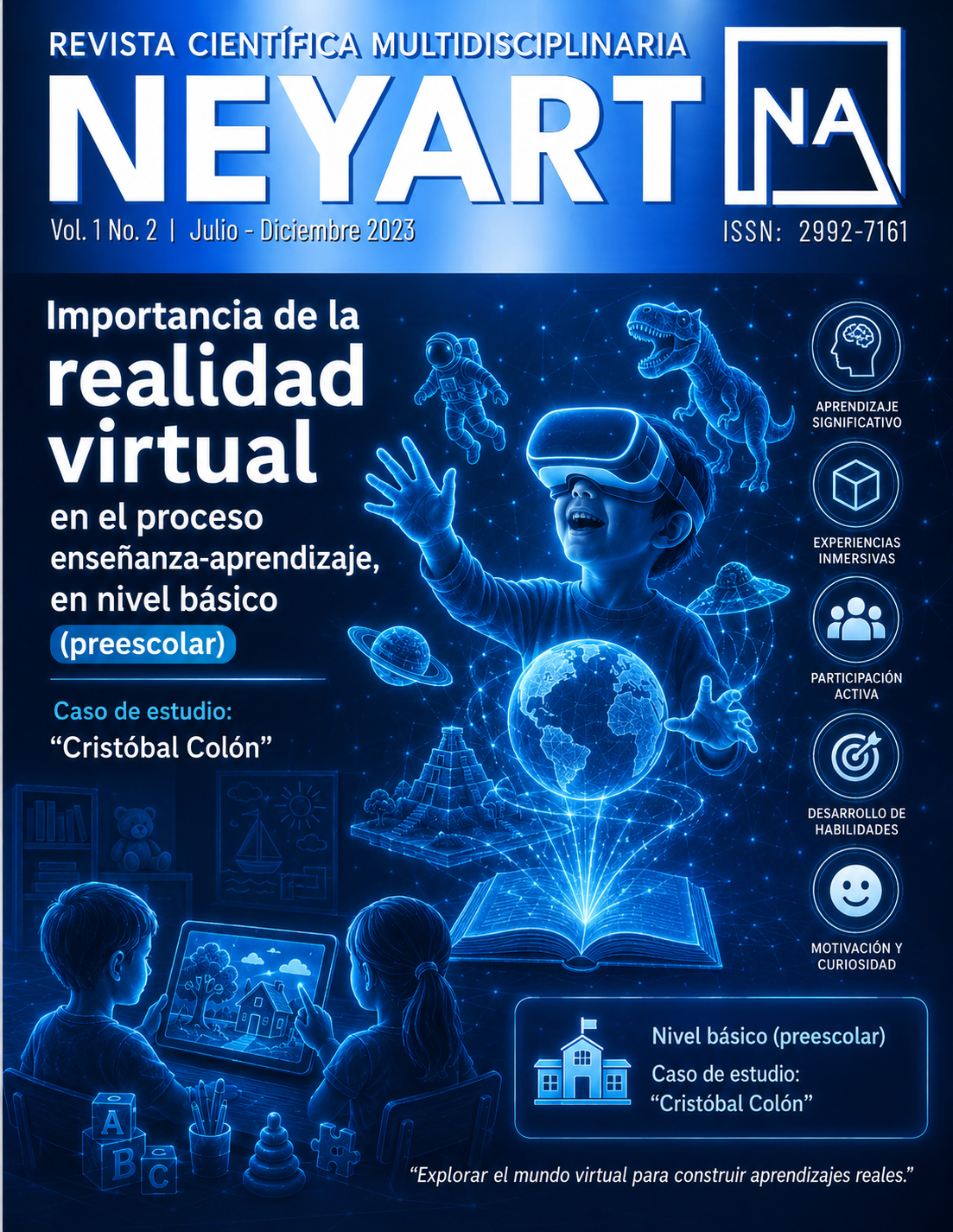
The Importance of Virtual Reality in the Teaching-Learning Process in Early Childhood Education: A Case Study of Christopher Columbus tune share more_vert
DOI:
https://doi.org/10.61273/neyart.v1i2.35Keywords:
Basic education, Virtual reality, Teaching and learningAbstract
This research project entitled "The Importance of Virtual Reality in the Teaching-Learning Process in Early Childhood Education: A Case Study of Christopher Columbus" aims to understand the importance of virtual reality in the teaching-learning process. It is a technology specially adapted for teaching due to its ease of capturing the attention of students through immersion in technological worlds related to different branches of knowledge. In this way, it can help in the learning of any subject. For this reason, a 10-question survey validated by Cronbach's Alpha with .87 was implemented. This refers to the fact that there is a level of significance, since having a measurement instrument is fundamental for any professional in their practice, to support the firmness they exercise day by day in their work. However, it is more important that such an instrument has satisfactory evidence of validity and reliability in its scores. However, Cronbach's Alpha has an impact on the accuracy of the results obtained from an instrument. Thanks to this research, three variables were studied: education, students, and virtual reality. On the other hand, according to the information provided by the survey, 55.5% of parents consider that virtual reality saves time and effort for both teachers and students. In the same way, they reflect with 44.2% that using Virtual Reality will lead to greater learning and more opportunities for education, as well as taking into account that 46.5% believe that it allows their children to achieve better results in their learning. Finally, innovation in the teaching-learning process allows for improved performance in students through dynamism and practicality for meaningful and quality learning.
Downloads
Metrics
References
Domínguez-Lara, S. A., & Soto, C. M. (2015). Por qué es importante reportar los intervalos de confianza del coeficiente alfa de Cronbach. Revista Latinoamericana de Ciencias Sociales, Niñez y Juventud, 13(2), 1326-1328. https://dialnet.unirioja.es/descarga/articulo/5167555.pdf
Escartín, E. R (s/f) La realidad virtual, una tecnología educativa a nuestro alcance. Pixel-Bit. Revista De Medios Y Educación, (15), 5–21. https://recyt.fecyt.es/index.php/pixel/article/view/61151ç
García Reyes, C., Valdovinos Rosas, R. M., Salgado Gallegos, M., Alejo Eleuterio, R., & Muñoz Jiménez, V. (2014). Realidad virtual y entornos virtuales como apoyo al acercamiento universidad-comunidad: el caso de la Facultad de Ingeniería de la UAEMex|. Apertura, 6(1),76-85https://www.redalyc.org/articulo.oa?id=68831999007
Garcés Freire, Enrique Xavier,Aponte Zurita, William Romario (2021) Aplicación de realidad virtual educativa sobre dinosaurios para niños de educación básica.Repositorio pucesa. https://repositorio.pucesa.edu.ec/handle/123456789/3127
Huyhua Quispe, R. d. P. (2022). Actitud hacia el Entorno Virtual de Aprendizaje en Estudiantes de una Universidad Nacional de Huancayo, 2021 [Tesis de Maestría]. https://repositorio.ucv.edu.pe/bitstream/handle/20.500.12692/81711/Huyhua_QRDP
López Domínguez, H., & Carmona Vázquez, H. (2017). El uso de las TIC y sus implicaciones en el rendimiento de los alumnos de bachillerato. Un primer acercamiento. Education in the Knowledge Society, 18(1),21-38. https://www.redalyc.org/articulo.oa?id=535554765002
Macià, M.(2016). La comunicación familia-‐escuela: el uso de las TIC en los centros de primaria. Revista Electrónica Interuniversitaria de Formación del Profesorado, 19(1), 73-‐83. DOI: http://dx.doi.org/10.6018/reifop.19.1.245841
Martín, V. M. L. (2014). La realidad virtual como recurso educativo en las ciencias experimentales. Tesis de licenciatura.
Miguélez-Juan, B., Núñez Gómez, P., & Mañas-Viniegra, L. (2019). La Realidad Virtual Inmersiva como herramienta educativa parala transformación social: Un estudio exploratorio sobre la percepción de los estudiantes en Educación Secundaria Postobligatoria.Aula abierta,48(2), 157. https://doi.org/10.17811/rifie.48.2.2019.157-166
Moreno Reyes, H., (2016). Incorporación de las TIC en las prácticas educativas: el caso de las herramientas, recursos, servicios y aplicaciones digitales de Internet para la mejora de los procesos de aprendizaje escolar. Reencuentro. Análisis de Problemas Universitarios, (72),71-92https://www.redalyc.org/articulo.oa?id=34051292006
Otero, L., Burgos, B. M. V., Suárez, S. L., Del Rocío Carriel Paredes, F., & Ortega, R. M. (2016). Uso de la realidad virtual, en la educación del futuro en centros educativos del Ecuador. Journal of Science and Research: Revista Ciencia e Investigación, 1(4), 26-30. https://doi.org/10.26910/issn.2528-8083vol1iss4.2016pp26-30SD.pdf?sequence=1&isAllowed=y
Sousa Ferreira, R., Campanari Xavier, R. A., & Rodríguez Ancioto, A. S. (2021). La realidad virtual como herramienta para la educación básica y profesional. Revista científica General José María Córdova, 19(33), 223-241. https://www.redalyc.org/articulo.oa?id=476268269011
Valarezo-Guzmán, G. E., Sánchez-Castro, X. E., Bermúdez-Gallegos, C., & García-Alay, R. (2023). Simulación y realidad virtual aplicadas a la educación. RECIMUNDO, 7(1), 432-444. https://doi.org/10.26820/recimundo/7.(1).enero.2023.432-444
VeraGuillermo Ocete, OrtegaCarrilloJosé Antonio, M.ª Ángeles Burgos González(2003)Vol. 2. 2-17 http://www.ugr.es/~sevimeco/revistaeticanet/index.htm
Zapatero Guillèn Daniel ( 2011) La realidad virtual como recurso y herramienta útil para la docencia y lainvestigación. TEyET, n.º 6, pp. p. 17–23. https://teyet-revista.info.unlp.edu.ar/TEyET/article/view/230
Downloads
Published

How to Cite
Issue
Section
License
Copyright (c) 2023 Brenda López Martínez, Fátima Yaraset Mendoza Montero , Ricardo García Parada , María Eugenia Astrid Macías Sagarminaga , Yearim Medina Molina

This work is licensed under a Creative Commons Attribution 4.0 International License.