
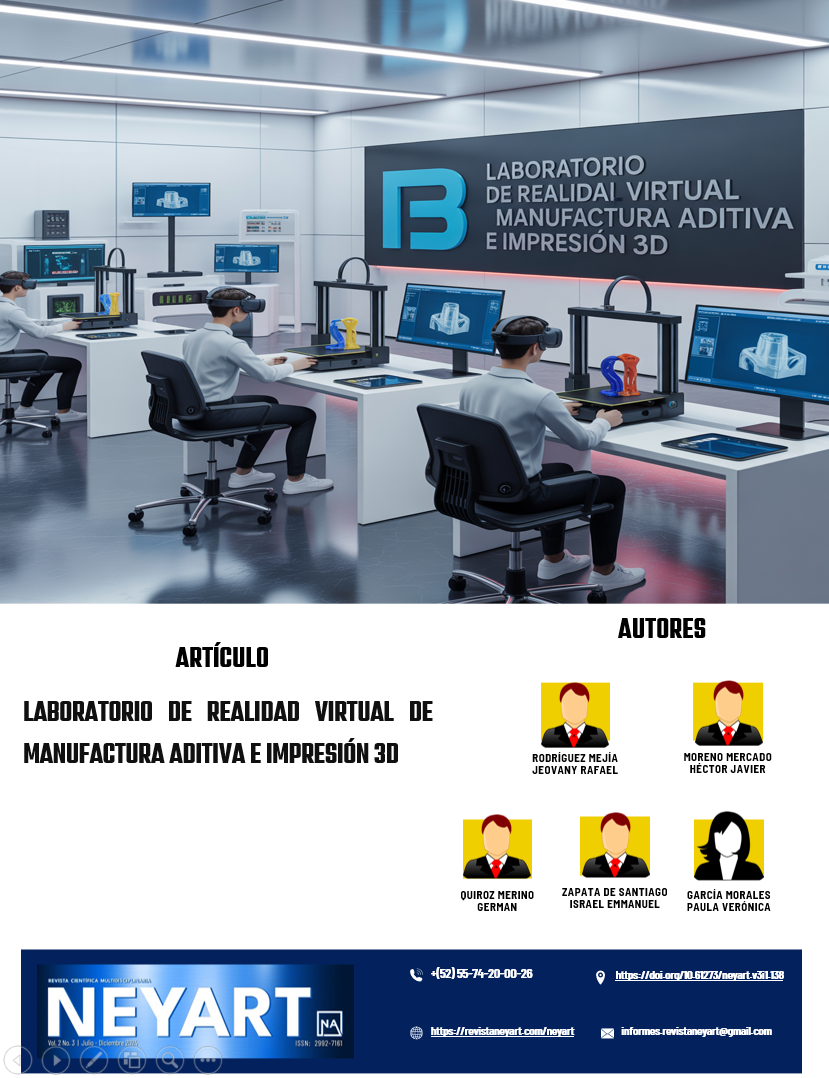
Vr lab of additive manufacturing and 3D printing
DOI:
https://doi.org/10.61273/neyart.v3i5.140Keywords:
3D Printing, Virtual laboratories, VirtualizationAbstract
This article presents the Virtual Reality Laboratory for Additive Manufacturing and 3D Printing (VR Lab), developed at the Tecnológico Nacional de México, Ciudad Juárez, and examines its potential impact on education and the manufacturing industry. The primary objective is to explore the feasibility and pedagogical and productive value of virtualizing 3D printing laboratories through virtual reality (VR), enabling immersive visualization and manipulation of three-dimensional models, simulation of additive manufacturing processes, and evaluation of geometries prior to fabrication. The convergence of 3D printing and VR is described as a platform for interactive learning, where students and professionals can engage with 3D objects, identify design flaws, optimize models, and gain a deeper understanding of proportions and process parameters within a safe and controlled environment. Key benefits include enhanced theoretical comprehension and practical skills, reduced risks and costs associated with prototyping, and the facilitation of collaboration and remote learning—particularly in contexts where physical experimentation is limited. Special emphasis is placed on critical industrial sectors such as automotive and aerospace, as well as on educational and training applications. The study highlights VR’s capacity to deliver a more immersive learning experience, support iterative design processes, and inform manufacturing decisions. It concludes that virtual reality in additive manufacturing laboratories holds significant transformative potential for education and technological innovation.
Downloads
Metrics
References
Abrar, T., & Ali, H. H. (2016). Integration of Oculus Rift based Virtual Reality with Unity 3D in a Driving Simulator. University of London, Londres, Informe tècnic, juny
Albahbah, M., Kıvrak, S., & Arslan, G. (2021). Application areas of augmented reality and virtual reality in construction project management: A scoping review. J. Constr. Eng. Manag. Innov, 4, 151-172. DOI: https://doi.org/10.31462/jcemi.2021.03151172
Asaad, R. R. (2021). Virtual reality and augmented reality technologies: A closer look. International Research Journal of Science, Technology, Education, & Management (IRJSTEM), 1(2).
Balsam, P., Borodzicz, S., Malesa, K., Puchta, D., Tymińska, A., Ozierański, K., ... & Opolski, G. (2019). OCULUS study: Virtual reality-based education in daily clinical practice. Cardiology journal, 26(3), 260-264. DOI: https://doi.org/10.5603/CJ.a2017.0154
Biocca, F. (1992). Communication within virtual reality: Creating a space for research. Journal of communication, 42, 5-5. DOI: https://doi.org/10.1111/j.1460-2466.1992.tb00810.x
Cardona, J. D., Hidalgo, M. Á., Castán, H., Rojas, F., Borro, D., & Jaramillo, H. (2007). Realidad virtual y procesos de manufactura (1ª ed.). Gestión Editorial Dirección de Investigaciones y Desarrollo Tecnológico. https://red.uao.edu.co/server/api/core/bitstreams/7abe348a-1127-4e2b-9356- df2ff50866d4/
Gigante, M.A.: “Virtual Reality: definitions, history and applications” En: Virtual Reality Systems, ed. by Earnshaw, R.A., Gigante, M.A. y Jones, H. London: Academic Press, 1993. DOI: https://doi.org/10.1016/B978-0-12-227748-1.50009-3
González Morcillo, C., D. Vallejo Fernández, et al. (2013). [e-Book] Realidad Aumentada. Un Enfoque Práctico con ARToolkit y Blender. Cáceres, Consorcio Identic, 2013.
Haba, C. (2024, Julio 19). Realidad Virtual en la Formación: El Futuro de la Educación – Innoarea Projects. Innoarea Projects. https://innoarea.com/noticias/realidad-virtual-formacion-construmadera.
Jaynes, C., Seales, W. B., Calvert, K., et al. (2003). The Metaverse: A Networked Collection of Inexpensive, Self-configuring, Immersive Environments. Proceedings of the Workshop on Virtual Environments 2003. EGVE ’03, Association for Computing Machinery. 115–124. https://dl.acm.org/doi/10.1145/769953.769967 DOI: https://doi.org/10.1145/769953.769967
Jerald, J., Giokaris, P., Woodall, D., Hartholt, A., Chandak, A., & Kuntz, S. (2014, March). Developing virtual reality applications with Unity. In 2014 IEEE Virtual Reality (VR) (pp. 1-3). IEEE. DOI: https://doi.org/10.1109/VR.2014.6802117
Kim, M. J., Wang, X., Love, P. E., Li, H., & Kang, S. C. (2013). Virtual reality for the built environment: a critical review of recent advances. Journal of Information Technology in Construction (ITcon), 18(14), 279-305.
Kumar, M. H., & Bal, S. (Eds.). (2024). A textbook on additive manufacturing technologies. Nova Science Publishers, Inc.
López, O. E. (2024, Septiembre 4). Tendencias de la manufactura aditiva revolucionan la producción. Mms-Mexico.com; Modern Machine Shop México. https://www.mms-mexico.com/columnas/tendencias-de-la-manufactura-aditivarevolucionan-la-produccion
Ma, D., Gausemeier, J., Fan, X., & Grafe, M. (2011). Virtual reality & augmented reality in industry. Shanghai Jiao Tong University Press; Springer. https://doi.org/10.1007/978-3-642-17376-9 DOI: https://doi.org/10.1007/978-3-642-17376-9
McLellan, H. (1993). Virtual reality goes to school. Computers in the Schools, 9(4), 5-12. DOI: https://doi.org/10.1300/J025v09n04_02
Nagta, A., Sharma, B., & Sharma, A. (2022, December). Oculus: a new dimension to virtual reality. In 2022 International Conference on Automation, Computing and Renewable Systems (ICACRS) (pp. 1169-1172). IEEE. DOI: https://doi.org/10.1109/ICACRS55517.2022.10029200
Omran, W., Ramos, R. F., & Casais, B. (2024). Virtual reality and augmented reality applications and their effect on tourist engagement: a hybrid review. Journal of Hospitality and Tourism Technology, 15(4), 497-518. DOI: https://doi.org/10.1108/JHTT-11-2022-0299
Pawassar, C. M., & Tiberius, V. (2021). Virtual reality in health care: bibliometric analysis. JMIR Serious Games, 9(4), e32721. DOI: https://doi.org/10.2196/32721
Roda-Segarra, J., Mengual Andrés, S., & Martínez-Roig, R. (2022). Using Virtual Reality in Education: a bibliometric analysis. DOI: https://doi.org/10.54988/cv.2022.1.1006
Samala, A. D., Daineko, Y., Indarta, Y., Nando, Y. A., Anwar, M., & Jaya, P. (2023). Global Publication Trends in Augmented Reality and Virtual Reality for Learning: The Last Twenty-One Years. International Journal of Engineering Pedagogy, 13(2). DOI: https://doi.org/10.3991/ijep.v13i2.35965
Todd, C. Game development in unity using oculus quest vr.
Yunsik, C. (2022). A study on the comparison of the virtual reality development environment in unity and unreal engine 4. Journal of the Korea Computer Graphics Society, 28(5), 1-11. DOI: https://doi.org/10.15701/kcgs.2022.28.5.1
Downloads
Published

How to Cite
Issue
Section
License
Copyright (c) 2025 Jeovany Rafael Rodríguez Mejía , Héctor Javier Moreno Mercado , German Quiroz Merino , Israel Emmanuel Zapata de Santiago , Paula Verónica García Morales

This work is licensed under a Creative Commons Attribution 4.0 International License.