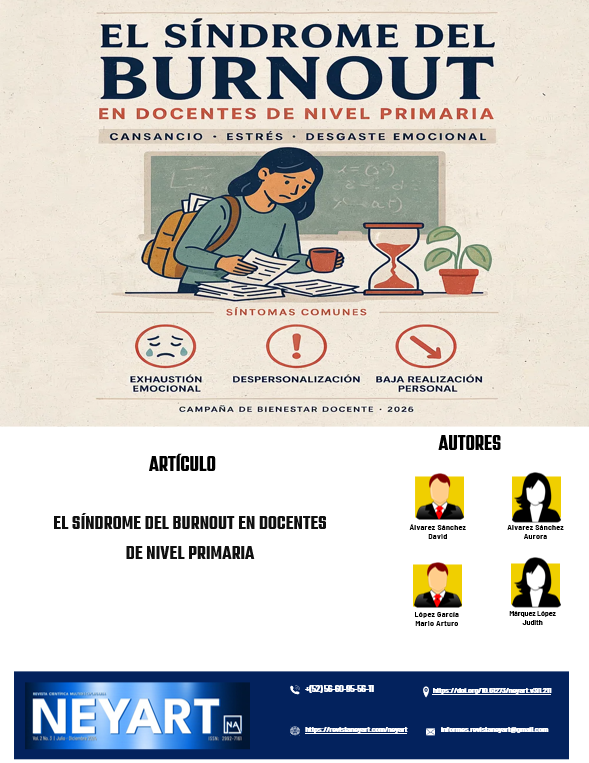
Burnout syndrome in primary school teachers
DOI:
https://doi.org/10.61273/neyart.v4i1.211Keywords:
burnout, emotional exhaustion, administrative burden, work burden, work environmentAbstract
This research presented the results of the design, piloting, and validation of a test to assess Burnout Syndrome in teachers who worked at Federal primary schools belonging to the Chihuahua State Education Services (SEECH). The objective was to classify the causes of burnout in teachers and it created a didactic guide that generated favorable environments, allowing for prevention within the institutions. With a mixed-methods approach and a descriptive study type, under the constructivist paradigm, data was collected for piloting, the test was designed and constructed, and it was subjected to a thorough evaluation by experts. It was applied to teachers and was reassessed by experts along with the guide. The design of the guide, which contained the test to assess burnout in teachers and the suggested techniques to prevent said syndrome, proved to be of great utility in exposing the real situation of teachers individually.
Downloads
Metrics
References
Aceves, J. E. (1994). Práctica y estilos de investigación en la historia oral contemporánea. Historia y Fuente Oral, (12), 143–150. https://www.jstor.org/stable/27753451
Arias, F. G. (2006). El proyecto de investigación: Introducción a la metodología científica (5.ª ed.). Episteme.
Barrientos, N. P., Araya, L., Veloso, V. A., y Herrera, C. M. (2019). Optimismo disposicional en docentes de universidades privadas en región metropolitana en Chile. Revista Arbitrada Interdisciplinaria Koinonía, 4(7), 168–184. https://doi.org/10.35381/R.K.V4I7.199
Berger, P., y Luckmann, T. (2003). La construcción social de la realidad (S. Zuleta, trad.; 1.ª ed.). Amorrortu Editores. (Trabajo original publicado en 1986)
Castro, L. (2012). Influencia del clima laboral en el síndrome de burnout, estudio realizado en una empresa de producción de la ciudad de Quetzaltenango [Tesis de licenciatura, Universidad Rafael Landívar]. http://biblio3.url.edu.gt/Tesario/2012/05/43/Castro-Leyvi.pdf
Centroalayon. (2018). El desgaste emocional o la consecuencia de exigirse ser fuerte. Antonio Alayón Noticias. https://www.antonioalayon.com/el-desgaste-emocional-o-la-consecuencia-de-exigirse-ser-fuerte/
D'Anello, S., Marcano, E., y Guerra, J. C. (2000). Estrés ocupacional y satisfacción laboral en médicos del Hospital Universitario de los Andes, Mérida, Venezuela. Medula, Revista de la Facultad de Medicina, Universidad de los Andes, 9(1-4), 4–9. http://erevistas.saber.ula.ve/index.php/medula/article/view/5667/5471
Díaz, F., y Gómez, I. C. (2016). La investigación sobre el síndrome de burnout en Latinoamérica entre el 2000 y el 2010. Psicología desde el Caribe, 33(1), 113–131. http://dx.doi.org/10.14482/psdc.33.1.8065
Farber, B. A. (1984). Stress and burnout in suburban teachers. The Journal of Educational Research, 77(6), 325–331. https://doi.org/10.1080/00220671.1984.10885550
Freire, C., Ferradás, M. d. M., Valle, A., Núñez, J. C., y Vallejo, G. (2016). Profiles of psychological well-being and coping strategies among university students. Frontiers in Psychology, 7, Artículo 1554. https://doi.org/10.3389/fpsyg.2016.01554
González, R., Souto-Gestal, A., González-Doniz, L., y Franco, V. (2018). Perfiles de afrontamiento y estrés académico en estudiantes universitarios. Revista de Investigación Educativa, 36(2), 421–433. https://doi.org/10.6018/rie.36.2.290901
Gutiérrez, N., Villasmil, J., y Rodríguez, N. (2016). Manejo de las competencias emocionales frente a la transformación curricular. CIENCIAMATRIA, 2(3), 152–170. https://doi.org/10.35381/cm.v2i3.46
Hederich-Martínez, C., y Caballero-Domínguez, C. C. (2016). Validación del cuestionario Maslach Burnout Inventory-Student Survey (MBI-SS) en contexto académico colombiano. CES Psicología, 9(1), 1–15. https://doi.org/10.21615/cesp.9.1.1
Kelchtermans, G., y Strittmatter, A. (1999). Beyond individual burnout: A perspective for improved schools. Guidelines for the prevention of burnout. En R. Vandenberghe y M. A. Huberman (Eds.), Understanding and preventing teacher burnout (pp. 304–314). Cambridge University Press. https://doi.org/10.1017/CBO9780511527784.022
Kyriacou, C., y Sutcliffe, J. (1977). Teacher stress: A review. Educational Review, 29(4), 299–306. https://doi.org/10.1080/0013191770290407
Lazarus, R. S., y Folkman, S. (1986). Estrés y procesos cognitivos (M. Zaplana, trad.). Martínez Roca.
Marqués, A., Lima, M. L., y Lopes da Silva, A. (2005). Fuentes de estrés, burnout y estrategias de coping en profesores portugueses. Revista de Psicología del Trabajo y de las Organizaciones, 21(1-2), 125–143. https://journals.copmadrid.org/jwop/art/22fb0cee7e1f3bde58293de743871417
Martínez, A. (2010). El síndrome de burnout, evolución conceptual y estado actual de la cuestión. Vivat Academia, (112), 42–80. https://doi.org/10.15178/va.2010.112.42-80
Maslach, C., y Jackson, S. E. (1986). Maslach Burnout Inventory (2.ª ed.). Consulting Psychologists Press.
Mulki, J. P., Lassk, F. G., y Jaramillo, F. (2013). The effect of self-efficacy on salesperson work overload and pay satisfaction. Journal of Personal Selling & Sales Management, 28(3), 285–297. https://doi.org/10.2753/PSS0885-3134280305
Navarro, J. (2016). Un poco de historia sobre el burnout, nuevo 2016. Revista Ideides, 6. https://revista-ideides.com/un-poco-de-historia-sobre-el-burnout-nuevo-2016/
Neidhardt, J. E., Weinstein, M. S., y Conry, R. F. (1989). Seis programas para prevenir y controlar el estrés. Deusto.
Oficina Internacional del Trabajo. (1984). Factores psicosociales en el trabajo: Naturaleza, incidencia y prevención. https://webapps.ilo.org/public/libdoc/ilo/1986/86B09_301_span.pdf
Organización Mundial de la Salud. (2000). The world health report 2000. https://cdn.who.int/media/docs/default-source/health-financing/whr-2000.pdf?sfvrsn=95d8b803_1&download=true
Organización Mundial de la Salud. (2024). Clasificación internacional de enfermedades (11.ª ed.). https://icd.who.int/browse/2024-01/mms/es#129180281
Pettegrew, L. S., y Wolf, G. E. (1982). Validating measures of teacher stress. American Educational Research Journal, 19(3), 373–396. https://doi.org/10.3102/00028312019003373
Randstad. (2015, 27 de junio). El 59% de los trabajadores en España sufre algún tipo de estrés en el trabajo. 20 Minutos. https://www.20minutos.es/noticia/2499561/0/59-trabajadores-espana/sufre-algun-tipo/estres-trabajo/
Santrock, J. (2002). Psicología de la educación. McGraw-Hill.
Silva, G. N., y Carlotto, M. S. (2003). Síndrome de burnout: Um estudo com professores da rede pública. Psicologia Escolar e Educacional, 7(2), 146. https://www.scielo.br/j/pee/a/pdSktmqxPPfyYZ9h4bt7Rch/?format=pdf&lang=pt
Smith, P. E. (2011). Collaborative teaching. ADE Bulletin, (151), 60–65. https://doi.org/10.1632/ade.128.60
Taylor, S. J., y Bogdan, R. (1987). Introducción a los métodos cualitativos de investigación (J. Piatigorsky, trad.; 2.ª ed.). Paidós.
Torres, E. F., Ali El-Sahili, L. F., y Gutiérrez, V. (2019). Análisis del burnout y sus escalas de medición. Praxis Investigativa ReDIE, 11(20), 106–124. https://dialnet.unirioja.es/descarga/articulo/6951593.pdf
Travers, C. J., y Cooper, C. L. (1997). El estrés de los profesores: La presión en la actividad docente (A. Remesal y D. Menezo, trads.; 1.ª ed.). Paidós.
UNAM DGCS. (2023). México, uno de los países con más fatiga por estrés laboral. Boletines de Dirección General de Comunicación Social. https://www.dgcs.unam.mx/boletin/bdboletin/2023_274.html
UNAM Global Revista. (2023). México: Alarmantes cifras de estrés laboral. UNAM Global Revista. https://unamglobal.unam.mx/global_revista/mexico-alarmantes-cifras-de-estres-laboral/
Weber, M. (1968). Basic sociological terms. En M. Weber, G. Roth, y C. Wittich (Eds.), Economy and society: An outline of interpretive sociology (pp. 3–62). University of California Press.