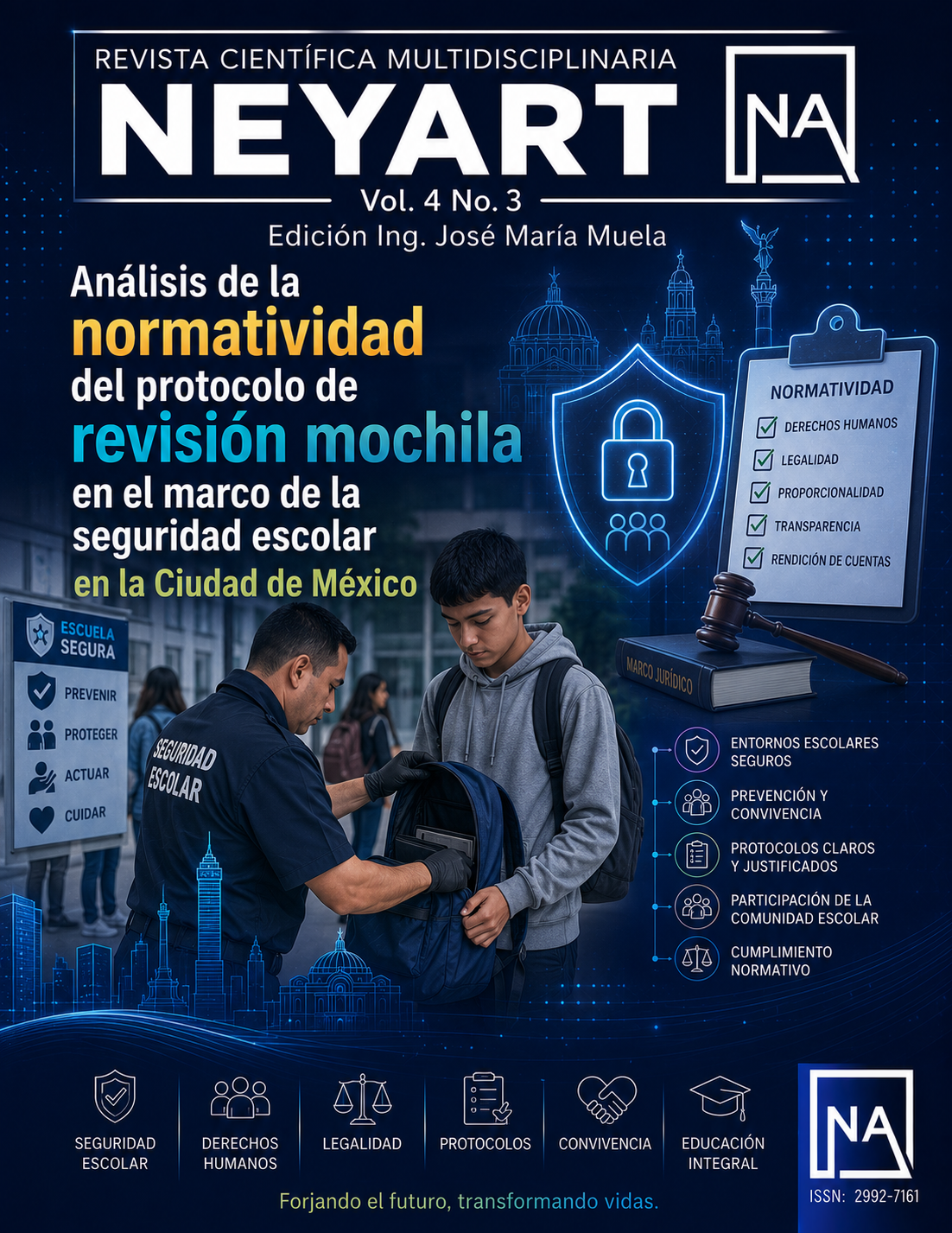
Analysis of the regulations of the backpack inspection protocol within the framework of school safety in Mexico City
DOI:
https://doi.org/10.61273/neyart.v4i3.193Keywords:
Culture of Peace, Prohibited Ítems, Backpack Check, School Safety, School ViolenceAbstract
The main objective of this paper is to critically examine the relevance and functionality of the Backpack Check Protocol as a preventive school safety measure in basic education institutions in Mexico City. To this end, its legal, educational, and theoretical foundations are analyzed, as well as its feasibility, scope, and limitations, particularly in contexts of high social vulnerability. This analysis seeks to assess its real contribution to both preventing the entry of prohibited items and building safe school environments, considering a shared responsibility approach among the school, the family, and the community.
Furthermore, the study addresses the central question: does backpack searches protect or violate students' rights? This question is explored within a context characterized by increased social violence and the growing presence of prohibited items in schools, such as knives, vapes, and illicit substances. Based on this, the article presents a critical analysis of the Backpack Search Protocol as a school safety strategy in Mexico City, from both a legal and pedagogical perspective, identifying its strengths, areas for improvement, and, above all, questioning its suitability in real-world application scenarios.
Methodologically, this work employs a qualitative and analytical approach, incorporating contributions from various educational, psychological, and sociological theories, including social learning, moral development, and social control. These perspectives are integrated across the board with the current national regulatory framework and contextual experience, allowing for a comprehensive understanding of the phenomenon. In this sense, the analysis reveals that the problem is not limited to the disciplinary dimension associated with the possession of dangerous objects, but is deeply linked to community, family, emotional, and social factors that influence adolescent behavior and the configuration of the school climate.
Finally, the study acknowledges that the Backpack Check Protocol can be a useful preventative measure for reducing immediate risks, provided it is applied in strict accordance with the law, with respect for human rights, and with the active participation of mothers, fathers, and guardians. However, it also points out its operational, pedagogical, and social limitations when implemented in an isolated, punitive, or merely administrative manner, as it can generate adverse effects such as the stigmatization of students, distrust in the school institution, and the creation of a false sense of control.
In this sense, the work argues that school safety cannot be guaranteed solely through physical checks, but requires a comprehensive strategy that articulates actions of prevention, socio-emotional education, strengthening of family co-responsibility and promotion of a culture of peace. Rather than taking a position for or against the protocol, the text invites us to rethink school safety from a formative, critical and humanistic perspective, where protecting implies not only controlling, but also educating, accompanying and understanding the complex realities that children and adolescents experience inside and outside the school environment.
Downloads
Metrics
References
Autoridad Educativa Federal en la Ciudad de México. (2021). Protocolo para la protección y cuidado de niñas, niños y adolescentes en la revisión de útiles escolares. https://www.angloamericanomexicano.com/Proyecto-Protocolo-revision-utiles-escolares180621.pdf
Banco Interamericano de Desarrollo. (2018). Asalto al desarrollo: Violencia en América Latina (Informe). https://publications.iadb.org/en/publications/spanish/viewer/Asalto-al-desarrollo-Violencia-en-Am%C3%A9rica-Latina%C2%A0.pdf
Bandura, A. (1987). Teoría del aprendizaje social. Espasa-Calpe. https://archive.org/details/bandura-a.-walters-r.-aprendizaje-social.-desarrollo-de-la%20personalidad
Becker, H. (2018). Outsiders: Hacia una sociología de la desviación. Siglo XXI Editores. https://vdoc.pub/documents/outsiders-hacia-una-sociologia-de-la-desviacion 5oonamr19qj0
Clarke, R. V. (1980). Prevención situacional del delito: Teoría y práctica. https://repositorio.gobiernolocal.es/xmlui/bitstream/handle/10873/855/claves06_09_felso n_clarke.pdf
Clarke, R. V. (1997). Prevención situacional del delito: Estudios de caso exitosos (2.ª ed.) https://es.scribd.com/document/833018611/Mo-dulo-de-prevencio-n-situacional
Erikson, E. H. (1993). Infancia y sociedad (6.ª ed.). Paidós. https://ia800605.us.archive.org/2/items/erikson-infancia-y-sociedad-8-edades de/Erikson_Infancia_y_Sociedad_8_Edades_de.pdf
Hirschi, T. (2003). Causas de la delincuencia. Editorial Trotta. (Obra original publicada en 1969 como Causes of delinquency). https://www.taylorfrancis.com/books/mono/10.4324/9781315081649/causes-delinquency-travis-hirschi
Instituto Nacional para la Evaluación de la Educación (INEE). (2007). Disciplina, violencia y consumo de sustancias nocivas a la salud en escuelas primarias y secundarias de México. (Informe). https://www.inee.edu.mx/images/stories/Publicaciones/Recursosyprocesos/Disciplina/Completo/disciplinacompletoa.pdf
Kohlberg, L. (1992). La filosofía del desarrollo moral. Editorial Desclée de Brouwer. https://es.scribd.com/document/363808330/Kohlberg-Psicologi-a-del-desarrollo-moral.
Ley General de Educación 2019 (Decreto publicado en el Diario Oficial de la Federación). https://portalhcd.diputados.gob.mx/LeyesBiblio/pdf/LGE_300919.pdf
Nelsen, J. (2016). Disciplina positiva. Ediciones Médici. https://cdn.bookey.app/files/pdf/book/es/disciplina-positiva.pdf
Ortega, R., & Del Rey, R. (2008). La convivencia escolar: Qué es y cómo abordarla. Gobierno Vasco. https://educagenero.org/Recursos/convivencia_Rosario-Ortega.pdf
Rapa, L. J., et al. (2024). School shootings in the United States: 1997–2022. Pediatrics, 153(3). https://publications.aap.org/aapnews/news/28391/Study-School-mass-shootings-becoming-deadlier.
Secretaría de Educación Pública. (2016). Programa Nacional de Convivencia Escolar. Gobierno de México. https://www.gob.mx/sep/documentos/s271-programa-nacional-de-convivencia-escolar?state=published
Secretaría de Educación Pública. (2018). Programa Nacional de Convivencia Escolar. Gobierno de México. https://www.gob.mx/sep/documentos/programa-nacional-de-convivencia-escolar-2017-2018?state=published
Secretaría de Educación Pública. (2019). Acuerdo número 28/12/19 por el que se emiten las Reglas de Operación del Programa Nacional de Convivencia Escolar para el ejercicio fiscal 2020. Diario Oficial de la Federación. https://educacionbasica.sep.gob.mx/wp-content/uploads/2022/06/S271-PNCE.pdf
Secretaría de Educación Pública. (2019). Lineamientos para la implementación del Protocolo de Revisión de Mochilas en Planteles Educativos. Gobierno de México. https://legislacion.edomex.gob.mx/sites/legislacion.edomex.gob.mx/files/files/pdf/gct/2025/mayo/may151/may151b.pdf
Secretaría de Educación Pública. (2022). Escuelas seguras y entornos protectores: Guía para directivos y docentes. Subsecretaría de Educación Básica, Gobierno de México. https://dggeyet.sep.gob.mx/convivencia_escolar/publicaciones/Entornos_Escolares_Seguros_vf.pdf.
Skinner, B. F. (1981). Sobre el conductismo. Fontanella. https://www.academia.edu/10249647/B_f_skinner_sobre_el_conductismo
Suprema Corte de Justicia de la Nación. (2019). Sentencia de la acción de inconstitucionalidad 6/2018 sobre el Protocolo de Revisión de Mochila. SCJN. https://www.scjn.gob.mx/tesis/jurisprudenciales-2019
UNESCO. (2018). Marco de acción para escuelas seguras: Lineamientos para la prevención de la violencia y la gestión de riesgos en el ámbito educativo. UNESCO. https://www.unesco.org/es/health-education/safe-learning-environments