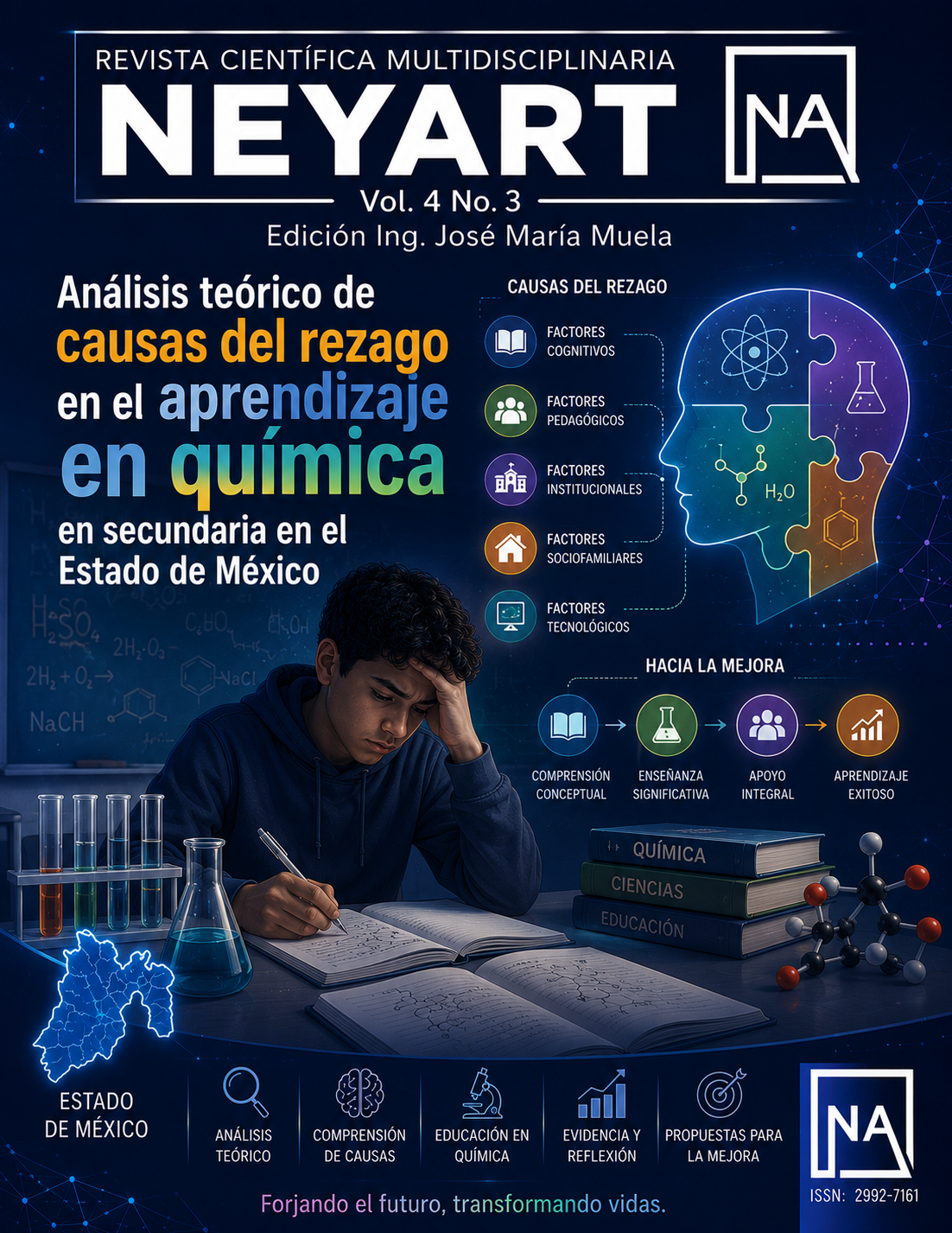
Theoretical analysis of the causes of learning gaps in chemistry at the secondary school level in the State of Mexico
DOI:
https://doi.org/10.61273/neyart.v4i3.192Keywords:
State of Mexico, chemistry, lagAbstract
The learning gap in Chemistry at the secondary school level in the State of Mexico represents a significant educational problem that affects academic performance and students’ motivation toward science. The complexity of the subject content, combined with deficiencies in prior knowledge such as reading comprehension and basic mathematics, hinders the learning process in this discipline.
The State of Mexico has one of the highest rates of educational lag at the national level, with a large proportion of the population that has not completed secondary education. This phenomenon is associated with multiple factors, including socioeconomic conditions, family environment, student demotivation, traditional teaching practices, and the lack of technological resources in schools.
This research adopts a qualitative approach to analyze the causes of academic lag in Chemistry among students under 15 years of age. It is identified that the disconnection between students and the school, as well as a negative perception of the subject, contributes to low academic performance and school dropout, particularly in exact sciences such as Chemistry and Mathematics.
Additionally, the limited use of dynamic teaching strategies and the scarce integration of technology as a pedagogical tool contribute to students’ lack of interest. Although there are proposals that highlight the educational potential of social networks and digital resources, their implementation faces obstacles such as insufficient teacher training and limited institutional support.
Downloads
Metrics
References
Ardura, D., Zamora, Á., & Pérez-Bitrián, A. (2020). The role of motivation on secondary school students’ causal attributions to choose or abandon chemistry. Chemistry Education Research and Practice, 22, 43-61.
Arango, L. G. (2006). Jóvenes en la universidad. Género, clase e identidad profesional. Siglo del Hombre Editores/Universidad Nacional de Colombia.
Barrios, M. (2017). Herramientas web como estrategia pedagógica para desarrollar el pensamiento científico en estudiantes de secundaria de Tenerife Magdalena. [Tesis Doctoral]. Universidad Rafael Belloso Chacín.
Bobadilla, A. J. A., Villarreal, F. S., Miranda, N. E. G., Bodek, D. F., & Gutiérrez, R. R. (2022). Diagnóstico de las causas de rezago y deserción en alumnos de la Facultad de Ciencias de la UNAM. RIDE Revista Iberoamericana Para la Investigación y el Desarrollo Educativo, 12(24). https:// doi.org/10.23913/ride.v12i24.1181
Bolívar, A. (2005). Equidad educativa y teorías de la justicia. REICE: Revista Electrónica Iberoamericana sobre Calidad, Eficacia y Cambio en Educación, 3(2), 42-69.
Castillo, A. (2013). El aprendizaje significativo de la Química: condiciones y estrategias para una mejor comprensión. Revista de Investigación Educativa.
Cruz-Vargas, M. S.(2023). El rezago educativo en México: apuntes y reflexiones. Revista Redalyc.
Delgado, V., Palet, J. E., & Olivares O. S. L. (2016). Aprendizaje basado en problemas en Química y el pensamiento crítico en secundaria. Revista Mexicana de Investigación Educativa, 21(69), 557-581.
Espinoza-Islas, V. M., Rubiales-Sánchez, F. S., & Santana-Galindo, A. L. (2022). Diagnóstico sobre rezago escolar en el Colegio de Ciencias y Humanidades. Revista RedCA, 4(12), 176-191.
Farinango, L. S., Cepeda, H. F., & Flores, M. C. (2024). Incidencia de la procrastinación en el rendimiento académico de la asignatura de Química. Revista Cátedra, 7(1), 152-169.
Flores, R. A. (2022). El impacto de la actuación docente en el rendimiento escolar: mirada del profesorado de Química. Ciencia Latina Revista Científica Multidisciplinar, 6(6), 14276-14291.
Hernández, D. E., & Silva, M. del S. (2021). Juegotecas Integrales: Espacio de Encuentro Educativo y Recreativo entre padres e hijos. Revista EDUCARE, 25(1), 334–355. https://doi.org/10.46498/ reduipb.v25i1.1317
Herrera A. E. M., Guzmán C. P., & Córdova C. Y. A., (2016). La importancia de la psicomotricidad gruesa en la primera infancia [Trabajo académico]. Corporación Universitaria Minuto de Dios. https:// repository.uniminuto.edu/handle/10656/4713
Kausar, F. N. (2024). Causes of students’ learning difficulties in secondary school chemistry: content and assessment strategies. Journal of Positive School Psychology.
Lamus, F. V., & Riquelme, C. S. (2020). Responsabilidad internacional por SARS-CoV-2 según el marco normativo de la Organización Mundial de la Salud. Revista Internacional de Derecho, 1(1), 38-56. https://doi.org/10.37768/unw.rid.01.01.003
Mateus, C. H., & Ramírez, S. M. (2022). Educación electiva en casa como alternativa para la educación inicial en tiempos de pandemia. REXE. Revista de Estudios y Experiencias en Educación, 21(47), 451-471. https://doi.org/10.21703/0718-5162202202102147024
Mendoza, J. (2019). El rezago educativo. Un problema de construcción social. Revista Digital A&H, 6(11), 44-57.
Olvera, A. C. & Gutiérrez, A. L. (2022). Pandemia, rezago y abandono escolar: Sus factores asociados.
Revista Andina de Educación, 5(2).
Osorio, E., Sánchez, L. T., Hernández, M. D. C., Carrillo, L., & Schnaas, L. (2010). Estimulación en el hogar y desarrollo motor en niños mexicanos de 36 meses. Salud Pública de México, 52(1), 14-22.
Oviedo, H. C., Campos Arias, A. (2005). Aproximación al uso del coeficiente alfa de Cronbach. Revista Colombiana de Psiquiatría, 34(4) 3-5.
Ponce, R. B. M., Hernández, A. M., Rubio, J. H., Carpio, A. R., & Torres, S. B. R. (2021). Programa SPSS. Educación Y Salud Boletín Científico Instituto De Ciencias De La Salud Universidad Autónoma Del Estado De Hidalgo, 10(19), 282-284. https://doi.org/10.29057/icsa.v10i19.7761
Salazar Hernández, D. E., y Silva, M. del S. (2021). Juegotecas Integrales: Espacio de Encuentro Educativo y Recreativo entre padres e hijos. Revista EDUCARE, 25(1), 334–355. https://doi.org/ 10.46498/reduipb.v25i1.1317